Differences and Similarities Between JIC and NPT Fittings
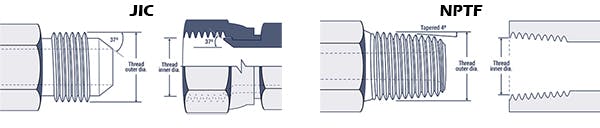
Looking for hydraulic components for hose assemblies and adapters can become a tedious task if you don’t have some level of basic understanding of them. Though hydraulic industries span across different regions of the world, they don’t conform to one unified standard.
It is essential to know these differences as the components manufactured under these standards may not be interchangeable. Selecting the wrong fitting for the job may result in thread wear, leaks, and improper connections. Here we look at the two most common types of fittings, NPTand JIC fittings, and identify their similarities and differences.
Standards
JIC fittings and adapters are based on the SAE J514 and MIL-DTL-18866 standards, whereas NPT fittings’ guidelines are outlined in the AMSE B1.20.1 standards. Both standards outline the characteristics, tolerances, and sizing variations for their respective components.
JIC fittings are often mistaken for other standards like SAE, AN, JIS, and Komatsu; however, subtle differences between them don’t make them interchangeable for use. We’ll get into these differences later on when we look at their characteristics and construction.
Threads
NPT, or National Pipe Tapered, gives you an indication of the kind of threads you can expect from these fittings. The threads are tapered, meaning they run at an angle of 1° 47’ 24" (measured from the center axis of the NPT fitting). On the other hand, threads on JIC fittings run parallel to each other across the axis of the fitting.
NPT threads have flat crests and troughs, containing a 60° angle between each successive thread. JIC thread guidelines are identical to the ones outlined in the SAE – J512 standard. They can come in coarse, fine, or extra-fine thread sizes, each representing the thread count and diameters for the threads on their relevant male and female parts.
It may be possible to thread similarly sized male NPT fittings onto female JIC fittings; however, the reverse case is not possible. This practice should not be followed as the taper on male NPT fittings means that deeper threads will not interlock properly.
Flare
Both NPT and JIC fittings are machined with tapered ends. This increases the surface area of contact between the seats on interlocking parts and serves to form a tight seal between the two. However, their flare angle differs. JIC fittings come with a 37° flare angle, while the NPT fittings rely on just their tapered threads for sealing. As a result, JIC fittings offer better sealing capabilities and can withstand higher working pressures.
Other standards like Komatsu also offer flared fittings, but they also have different flare angles (30°). Also, as mentioned earlier, JIC thread sizing is identical to the SAE – J512 standard, but they differ in their flare angles and therefore are not interchangeable.
Which One Should You Use?
NPT fittings have been around for a while and come in many types, shapes, and sizes. However, the standard hasn’t evolved much since it was outlined. The ubiquity of parts may make it much more feasible for use in hydraulic systems, but its sealing properties are much to be desired when considering high-pressure applications. Hence, you may need to consider your working conditions before choosing NPT or JIC fittings.
Frequently Asked Questions
What are the most common types of pipe fittings?
The most common types of pipe fittings include couplings, elbows, tees, reducers, adapters, unions, and caps. Each serves a specific purpose in a piping system. Couplings connect pipe sections, elbows change flow direction, tees split or combine flow, and reducers connect different pipe sizes.
At Titan Fittings, we offer a variety of stainless steel fittings designed to provide secure, reliable connections for industrial, hydraulic, and fluid-transfer applications.
How do I measure pipe fittings accurately?
To measure pipe fittings accurately, first identify whether the connection has male or female threads. Measure the outside diameter of male threads or the inside diameter of female threads using a caliper. Next, determine thread pitch using a thread gauge and identify the thread standard, such as NPT or BSP.
Compare these measurements with a thread identification chart. Also verify the nominal pipe size, connection type, and applicable pipe schedule to ensure compatibility.
Titan Fittings provides technical resources to help customers identify and select correctly sized fittings.
What are brass pipe fittings used for?
Brass pipe fittings are commonly used in plumbing, water distribution, compressed air systems, HVAC equipment, and certain industrial applications. Brass offers good machinability, moderate strength, and corrosion resistance in compatible environments.
However, stainless steel may be a better choice for demanding industrial applications involving high pressures, aggressive fluids, or corrosive environments.
Titan Fittings helps customers evaluate fitting materials based on application requirements, pressure ratings, temperature, and fluid compatibility.
How do I connect two pipes of different sizes?
To connect pipes of different sizes, use a reducing coupling, reducer, or reducing adapter that matches the pipe diameters and connection types.
Concentric reducers maintain a common centerline, while eccentric reducers provide an offset that may be useful for drainage, venting, or avoiding air pockets in certain piping configurations.
Titan Fittings offers stainless steel reducers and adapters for connecting different sizes and fitting configurations while maintaining system integrity.
What industries commonly use pipe fittings?
Pipe fittings are essential in oil and gas, chemical processing, industrial manufacturing, hydraulic equipment, HVAC, agriculture, food processing, and data center liquid cooling.
These industries depend on fittings to connect components, control flow direction, accommodate diameter changes, and maintain reliable fluid or gas transportation.
Titan Fittings supplies industrial fitting solutions for applications requiring dependable performance, material compatibility, and pressure-rated connections.
Why is it important to choose the right pipe fitting?
Choosing the correct pipe fitting helps prevent leaks, pressure loss, premature wear, corrosion, and unexpected equipment downtime.
An improperly selected fitting can compromise system reliability even when the surrounding equipment is correctly specified.
At Titan Fittings, we recommend evaluating material grade, pressure and temperature ratings, thread compatibility, connection dimensions, and operating conditions before selecting a fitting.
Are stainless steel fittings better than brass fittings?
Stainless steel fittings are often preferred for demanding industrial applications because of their strength, durability, and corrosion resistance. Brass fittings are generally more economical and easier to machine, making them suitable for many lower-pressure plumbing and general-purpose applications.
Neither material is universally better. Titan Fittings recommends selecting the material that best matches the operating pressure, fluid chemistry, temperature, environment, and service-life requirements.
Are stainless steel fittings stronger than brass fittings?
Stainless steel fittings generally offer higher mechanical strength than comparable brass fittings, making stainless steel a frequent choice for demanding industrial and high-pressure applications.
However, actual fitting performance depends on the alloy, geometry, manufacturing process, temperature, and published pressure rating.
Titan Fittings recommends selecting fittings based on verified component ratings rather than assuming every stainless steel fitting can withstand higher pressure than every brass fitting.
Which fitting material (Brass or Stainless Steel) is better for high-pressure hydraulic systems?
Stainless steel is often a preferred material for high-pressure hydraulic applications because of its mechanical strength and durability.
However, the correct choice depends on the specific fitting's rated working pressure, sealing design, temperature, and compatibility with the hydraulic fluid.
Titan Fittings recommends using pressure-rated stainless steel hydraulic fittings that meet the system's operating and applicable safety requirements.
Can compression fitting ferrules be reused?
Compression fitting ferrules undergo controlled deformation during their initial installation to grip the tubing and establish a reliable seal.
Previously swaged ferrules generally should not be removed and installed on new tubing because their deformation and gripping characteristics have changed.
Titan Fittings recommends using new ferrules for new tube connections. Reassembly of an existing fitting with the original ferrules attached to the same tubing is a separate procedure that may be permitted by the manufacturer.
What causes reused compression fittings to leak?
Compression fittings may leak after improper reuse because of damaged ferrules, altered sealing surfaces, scratched tubing, contamination, misalignment, or incorrect reassembly.
Removing preswaged ferrules and attempting to install them on different tubing can also compromise the original gripping and sealing geometry.
Titan Fittings recommends inspecting previously assembled components and replacing damaged parts before returning a connection to service.
When should instrumentation fitting ferrules be replaced?
Ferrules should be replaced when they show damage, cracking, excessive wear, corrosion, or other conditions that compromise sealing performance.
New ferrules are generally required when creating a new connection on fresh tubing rather than reassembling an existing qualified assembly.
Titan Fittings recommends following the applicable fitting manufacturer's replacement and reassembly instructions instead of reusing questionable components.
How do you prevent galling in stainless steel threaded fittings?
Thread galling can be reduced by using compatible lubricants or anti-seize compounds where appropriate, keeping threads clean, avoiding cross-threading, and preventing excessive tightening speed or force.
Properly matching threads and following manufacturer installation instructions are also essential.
Titan Fittings recommends inspecting threaded components before assembly and replacing fittings with damaged threads.
Can stainless steel fittings be reused after galling occurs?
Fittings with significant galling, torn threads, or seizure damage generally should not be reused.
Damaged threads can compromise engagement, sealing performance, and the connection's mechanical integrity.
Titan Fittings recommends replacing visibly damaged components rather than attempting to restore severely galled threads for pressure-containing service.
More questions: Pipe Fittings: Types, Applications & Selection