What are Hydraulic Hose Swivels and When to Use Them?
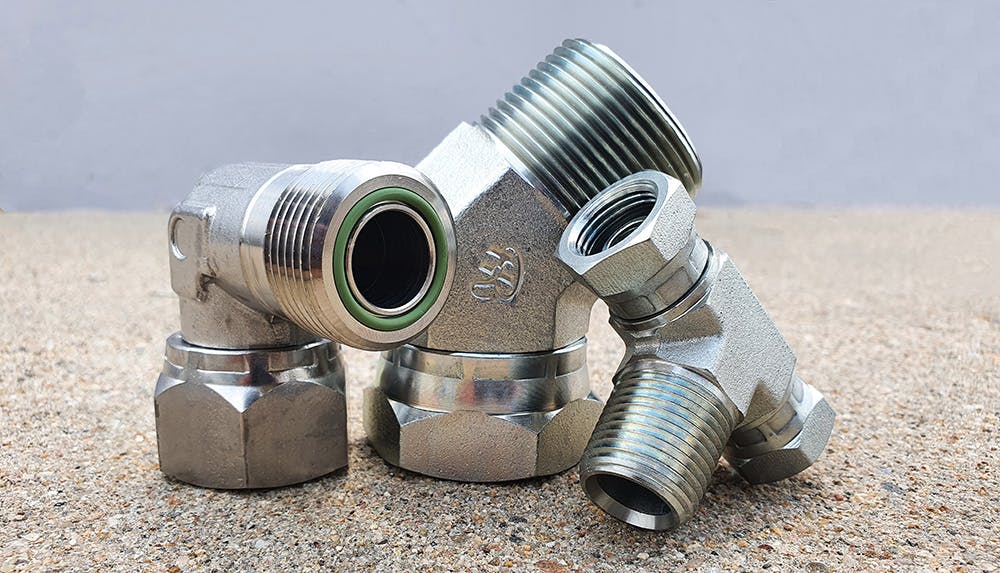
When designing and assembling components in a hydraulic system, technicians and engineers often face challenges when it comes to routing hydraulic hose assemblies. They have to visualize the system in operation to ascertain motions and vibrations that can put stress on hoses or cause abrasions. Failure to include these factors may result in hydraulic fluid leaking out, damage to the machine and its surrounding, and safety risks. Cases like these require swivel fittings
What are Hydraulic Hose Swivels?
Swivel-type fittings are manufactured in a way that allows them to rotate about their axis. Using these fittings with hose assemblies prevents excessive twisting, kinking, and bending of the hose, prolonging its life and reducing downtimes for maintenance.
Most swivel fittings consist of two parts: a stem which is the stationary part that connects to the body of the existing hydraulic system, and housing that sits on top of the stem, secured by a locking nut. Other designs include internal sealing mechanisms and ball bearings for restricted or unrestricted motion.
Tight tolerances and manufacturing guidelines allow them to be used in high-pressure applications as well. Hence, they offer leak-proof performance while resisting sudden jerks and loads that come with a hydraulic system’s operation. Depending on the complexity of the fitting, the range of motion it offers, and the quality of parts, they do tend to wear out with time. However, modern designs come with simple repair solutions and replacement parts.
Why use Hydraulic Hose Swivels?
Hydraulic hose swivels find usage in many industrial applications by allowing a range of motion, leading to simpler hydraulic system designs, and permitting faster maintenance regimes. Here are some applications that require swivel fittings.
Hydraulic Actuators
Hydraulic machinery is prevalent in many industries like the mining, aerospace, and automotive industries. They rely on hydraulic actuators to exert excessive forces and torque depending on their application. The movement of hydraulic actuators causes an extension or contraction in the hydraulic lines connected to their adjoining hydraulic cylinders. Hence, having fittings that can accommodate this range of motion becomes a necessity to prevent lines from twisting and weakening at the fittings.
Robotic Arms
Robotic arms are one of the most sophisticated and complex hydraulic systems commonly found in manufacturing installations. They need to perform repetitive tasks with high precision and control with a high degree of freedom of movement in multiple axes. Although motors can also be used in this application, hydraulic fluid offers more torque and control.
Their movement at high torque has the potential to strip away lines from their socket leading to devastating hydraulic system failure and costly repairs. Considering the degree of movement required, it leaves no option but to use swivel fittings in this application.
This phenomenon is particularly apparent in mining machinery required for digging and striking rocks. These kinds of machinery are far larger and complex than most hydraulic systems, given their sheer size and the amount of work they need to perform. They operate at higher pressures as well and require heavy-duty parts to sustain them.
To compensate for surges, designers tend to lengthen the lines. However, this practice adds to the cost of an already expensive system. Using hydraulic hose swivels eliminates the need for this practice, making the system more compact and reducing the budget.
Associated FAQs: Pipe Fittings
Frequently Asked Questions
How does temperature affect the lifespan of hydraulic hoses?
Temperature significantly affects hydraulic hose performance and service life. Excessive heat can accelerate deterioration of the inner tube, reduce flexibility, and weaken hose materials.
Repeated temperature fluctuations cause expansion and contraction, increasing the risk of cracking, fatigue, and leaks.
Operating hydraulic hoses within their specified temperature ratings, maintaining proper fluid temperatures, and performing regular inspections can help extend their service life and prevent unexpected failures.
What is the difference between hydraulic hoses and coolant hoses?
Hydraulic hoses are typically designed to transport pressurized hydraulic fluids, including petroleum-based oils, while coolant hoses are engineered to handle water-based fluids, glycol mixtures, and other cooling solutions.
Their inner tube materials, reinforcement, and chemical compatibility requirements may differ. Some rubber compounds suitable for hydraulic oil can deteriorate when exposed to water-based coolants.
Selecting a hose specifically rated for the operating fluid, pressure, and temperature is essential for preventing leaks and premature failure.
What type of hose is best for glycol-based and water-based coolant systems?
Hoses constructed from chemically compatible materials, such as appropriately formulated EPDM or silicone, are commonly used in glycol-based and water-based cooling systems.
EPDM often provides good resistance to water and certain glycol mixtures, while silicone offers flexibility across a broad temperature range.
However, suitability depends on the specific coolant formulation, operating pressure, temperature, and hose construction. Always verify the manufacturer's chemical compatibility specifications before selecting a coolant hose.
Why are flexible hose connections important in data center liquid cooling systems?
Flexible hose connections accommodate misalignment, thermal expansion, and vibration between cooling headers and server racks.
Unlike rigid piping, flexible hoses allow movement without transferring excessive mechanical stress to fittings, valves, and connections.
They also simplify installation and maintenance in confined rack spaces. Properly designed flexible hose assemblies help reduce the risk of fatigue, leaks, and connection damage while supporting reliable coolant circulation in liquid-cooled data centers.
How do you prevent leaks and premature failure in hydraulic and coolant hoses?
Preventing hose failure begins with selecting materials compatible with the operating fluid, pressure, and temperature. Proper installation is equally important, including maintaining the manufacturer's minimum bend radius, avoiding twisting, supporting hose assemblies, and preventing abrasion against surrounding equipment.
Regular inspections can identify cracking, swelling, leaks, and damaged fittings before major failures occur. Using correctly rated fittings and maintaining stable operating temperatures also helps extend hose life.
How do you select the correct flexible hose for a data center rack drop?
Selecting a flexible hose for a data center rack drop requires evaluating coolant type, flow rate, operating pressure, temperature, hose length, and installation geometry.
The hose must accommodate movement between the cooling header and rack without exceeding its minimum bend radius or placing excessive stress on end fittings. Material compatibility with deionized water, glycol blends, or other approved coolants is essential.
Properly matched stainless steel fittings and secure hose support can further improve connection reliability and reduce maintenance requirements.
More questions: Hoses