304 vs 316L Stainless for Data Center Coolant Loops
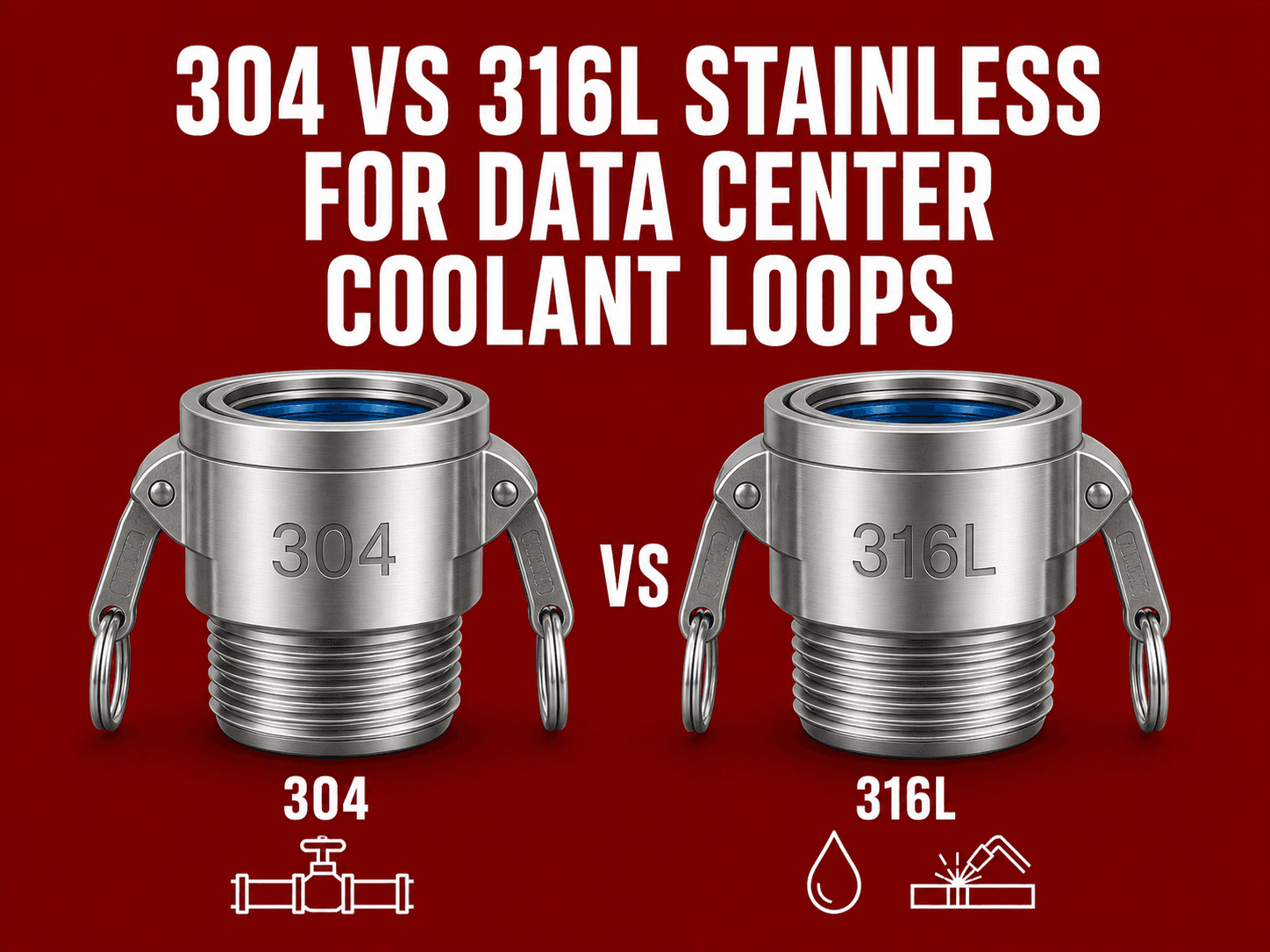
304 vs 316L Stainless for Data Center Coolant Loops
Walk a liquid-cooled hall and you'll find both grades in service — 304 and 316L stainless, often within a few feet of each other. That's not indecision; it's design. The two aren't rivals where one wins and the other loses. They're tools for different parts of the loop, and the useful question isn't "which is better" but "which belongs where." Spec 316L everywhere and you've spent money you didn't need to; spec 304 everywhere and you've cut corrosion margin on the part of the loop that can least afford it.
Here's what separates the two grades, and how to place each one.
The two grades, briefly
Both are austenitic stainless steels — the familiar chromium-nickel family that gives you corrosion resistance, strength, weldability, and a long service life in one material. They're close cousins. The differences come down to two things 316L adds.
Molybdenum. 316L includes a few percent molybdenum that 304 doesn't. Molybdenum sharpens resistance to pitting and to chloride attack — the localized corrosion that starts as a pinhole and works its way through. In a coolant loop, that's insurance against whatever the water chemistry throws at the metal over a decade.
Low carbon. The "L" means low carbon. When stainless is welded, ordinary carbon content can precipitate at the weld and leave the zone next to it vulnerable to corrosion — a problem called sensitization. Low-carbon 316L resists that, which matters anywhere the loop is welded rather than mechanically joined: manifolds, fabricated assemblies, custom tubing runs.
304, for its part, isn't a lesser metal — it's a workhorse. It delivers strong general corrosion resistance and full structural strength at a lower cost, because it skips the molybdenum and the extra alloying that push 316L's price up.
Where 304 earns its place
304 is the right call where the chemistry is controlled and the service is straightforward: structural duty, distribution runs, and the parts of the system where the fluid is managed and the corrosion demands are ordinary. On the facility side and across conventional distribution, 304 carries the load at a lower cost without giving anything up that the application needs. Blanket-specifying 316L over these runs is spending for a margin the conditions don't require.
Where 316L earns its place
316L is worth its premium on the clean, demanding parts of the loop:
- The clean secondary loop, where coolant runs to the racks and eventually to cold-plate microchannels, and corrosion margin and cleanliness both matter more.
- Deionized water service, where the tighter corrosion budget rewards the extra resistance moly provides.
- Welded manifolds and fabricated assemblies, where the low-carbon chemistry protects the weld zones.
- Fittings and adapters at the connections that have to stay leak-tight for the life of the facility, where the cost of the upgrade is small next to the cost of a failure.
The through-line: reach for 316L where the fluid is cleaner, the corrosion budget is tighter, the part is welded, or the joint is one you never want to revisit.
The cost angle, handled honestly
316L costs more — the molybdenum and richer alloying see to that. The temptation is to standardize on one grade to simplify purchasing, and if you're going to standardize, 316L is the safe direction because it covers everything 304 does and more. But a large network built entirely in 316L carries real cost that the controlled, lower-demand runs never cash in. The better discipline is to place each grade where it earns its keep: 316L where conditions are demanding, 304 where they're not. On a build with thousands of connections, that placement adds up.
A word on coolant
Both grades have to live with the coolant — PG25, deionized water, or a water-glycol blend — for the life of the loop, and the fluid chemistry is part of the grade decision. Deionized water in particular rewards the tighter corrosion margin of 316L on the clean side. (We cover coolant-and-material compatibility in more depth in a companion article.)
Where Titan fits
Titan is a single-source solution provider for the connections these systems depend on — the adapters, fittings, quick disconnects, and valves you have to spec. And because Titan manufactures in the US, it turns orders around with one of the fastest lead times in the industry: weeks, not months.
Titan Fittings supplies both grades — 304 and 316L — across transition fittings, isolation ball valves, flexible hose connections, and 1-inch OCP LQC quick disconnects, so you can place each grade where the loop calls for it rather than over-spec the whole network. We'll help you match the grade to the location, and keep the metals consistent through the connection so nothing dissimilar ends up in the coolant path.
Tell us your loop and we'll help you spec it. For the bigger picture, see the full-loop overview, and for why the industry went stainless in the first place, why stainless beat brass and plastic.