How to Choose the Right British Threaded Adapter?
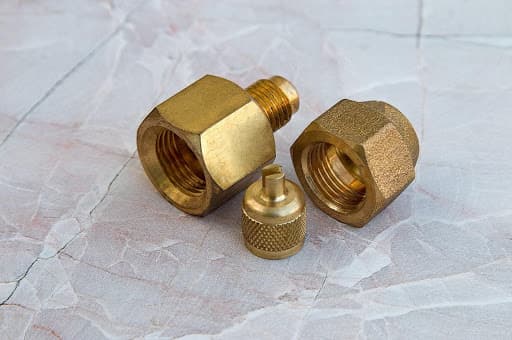
If you have ever struggled to attach your tubes and pipes to water outlets, you know the importance of getting the right threaded fitting for your plumbing installations. A hose with an incorrect diameter can make it difficult for you to attach the pipe to the outlet because either it will be too small and will not fit on the outlet or will be too big and loose, leading to slippage and leakages.
In such cases, you need the correct threaded piping that will act as a low-cost fixture for your domestic water supply, fire hydrant, or industrial cooling systems. Generally, threaded fittings or adapters are made of carbon steel, cast gray, cast brass, cast bronze, malleable iron, or forged alloy to ensure durability and make them resistant to water damage and rust.
How to Identify and Choose the Right British Threaded Adapter
British Standard Pipe Parallel (BSPP) Threaded Adapters
The BSPP thread adapters usually have a 30-degree chamfer on the male thread and a 30-degree cone seat inside the female thread. The parallel threads can be sealed or connected using an O-ring, a bonded washer, or an elastomeric sealant so that it can be used for port application.
You can identify a BSPP thread adapter by going through the following steps:
- Look closely and check whether the threads are tapered or parallel
- Use a thread gauge or calipers to check the threads per inch count
- Use calipers to distinguish the male thread (O.D) from the female thread (I.D)
- Sum up your O.D and I.D measurements
- Use the sum of your O.D and I.D measurements and your thread per inch count to find the correct BSPP thread adapter by using the specification chart.
- Use the seal or the angled sealing surface to determine which British threaded adapter will be a perfect fit for you.
British Standard Pipe Tapered (BSPT) Threaded Adapters
The BSPT threaded adapters can be sealed through thread wedging, and additional support can be provided by a thread tape or dope. The male thread of a tapered fitting can be connected to a female thread of the parallel fitting as long as the female thread does not swivel and is fixed.
In North America, the most common BSPT fitting is the NPT fitting. The NPT fitting has a chamfered sealing surface. On the othered hand, the BSPT fitting has a flat sealing surface. To determine the correct BSPT threaded adapter, you must consider the following steps:
- Use a caliper to check for the number of threads per inch count
- Use a caliper to measure the male thread (O.D) starting from the 4th thread until the end of the fitting.
- Use the same method to measure the female thread (I.D)
- Use the BSPT thread specification chart to find the best BSPT threaded adapter.
Frequently Asked Questions
What is the difference between NPT and BSP threads?
NPT (National Pipe Taper) and BSP (British Standard Pipe) are different thread standards used in industrial piping systems.
NPT threads have a 60-degree thread angle and are typically tapered. BSP threads have a 55-degree thread angle and are available in tapered (BSPT) and parallel (BSPP) configurations.
These differences affect thread engagement, sealing methods, and compatibility. Titan Fittings recommends identifying the correct standard before installing or replacing threaded components.
Can NPT and BSP fittings be connected together?
NPT and BSP fittings generally should not be connected directly because their thread angles, pitches, and profiles differ.
Although some sizes may appear similar and partially engage, mixing incompatible threads can result in leaks, damaged fittings, or connection failure.
Titan Fittings recommends using an appropriately rated NPT-to-BSP adapter when transitioning between thread standards.
How can you identify NPT versus BSP threads?
NPT and BSP threads can be identified by measuring thread diameter and pitch, checking whether the threads are tapered or parallel, and comparing their dimensions against recognized thread standards.
NPT threads use a 60-degree thread profile, while BSP threads use a 55-degree profile.
A thread pitch gauge, caliper, and reference chart are the most practical tools for identification. Because some thread sizes are very similar, Titan Fittings recommends verifying multiple dimensions rather than relying on appearance alone.
What is the difference between BSPT and BSPP threads?
BSPT (British Standard Pipe Taper) threads are tapered and typically use thread engagement with an appropriate sealant to create a pressure-tight connection.
BSPP (British Standard Pipe Parallel) threads have a constant diameter and generally rely on a sealing washer, O-ring, bonded seal, or another designed sealing surface.
Titan Fittings recommends confirming both the thread type and intended sealing method when choosing BSP fittings.
Do NPT and BSP threads require different sealing methods?
Yes. NPT threads commonly use a compatible thread sealant to fill the small gaps between engaged threads.
BSPT connections may also require thread sealant, while BSPP connections typically seal through a washer, O-ring, or dedicated sealing surface rather than the threads themselves.
Titan Fittings recommends using the sealing method specified for the connection and fluid service. Thread sealant should not be applied indiscriminately to every fitting type.
How can I tell whether a pipe fitting is NPT or BSP?
Start by measuring the fitting's thread diameter with a caliper and checking the thread pitch with a gauge. Next, determine whether the thread is tapered or parallel.
Compare these measurements against NPT and BSP thread charts to identify the correct standard. A visual inspection alone is not reliable because some sizes look nearly identical.
Titan Fittings offers thread identification resources to help customers verify compatibility before ordering replacement components.
How do I measure male and female pipe threads?
For male pipe threads, use a caliper to measure the outside thread diameter. For female pipe threads, measure the internal thread diameter at an accessible reference point.
Next, determine the threads per inch (TPI) or pitch using a thread gauge. For tapered threads, measurement location matters because the diameter changes along the thread.
Titan Fittings recommends comparing the measurements with an appropriate thread standard chart rather than assuming the measured diameter equals the nominal fitting size.
What is the difference between nominal pipe size and actual diameter?
Nominal Pipe Size (NPS) is a standardized designation used to identify pipe sizes. It does not always equal the actual inside or outside diameter.
For example, a nominal 1-inch pipe has a standardized outside diameter of 1.315 inches. Its inside diameter varies with wall thickness and pipe schedule.
Titan Fittings recommends checking nominal size, actual dimensions, and pipe schedule when choosing fittings, reducers, or adapters.
How do I determine the correct replacement pipe fitting?
To identify a replacement fitting, verify the existing fitting's connection type, thread standard, nominal size, material, and pressure rating.
Also check the system's operating temperature, fluid compatibility, and sealing requirements.
Titan Fittings recommends matching the complete fitting specification rather than relying on physical appearance or approximate thread engagement. This helps reduce leakage, installation problems, and premature component failure.
What tools are needed to measure pipe fittings accurately?
Common measurement tools include a digital or vernier caliper, thread pitch gauge, ruler, and pipe-thread identification chart.
For more demanding inspections, specialized thread gauges and calibrated measuring equipment may be necessary.
Titan Fittings recommends recording thread diameter, pitch, thread type, and nominal size before ordering replacement fittings.
More questions: Pipe Thread Identification, Sizing & Standards