Types of Stainless Steel Hose Fittings
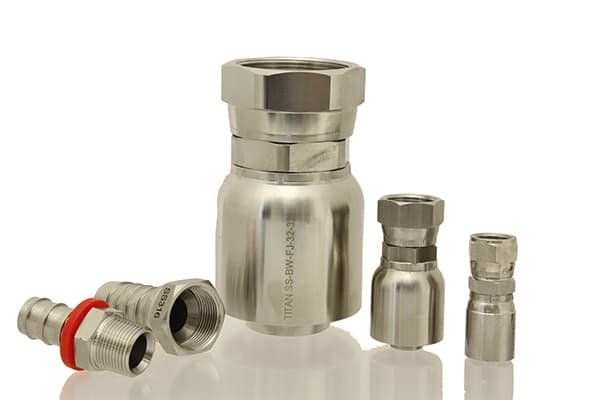
In plumbing and other hydraulic systems, hose fittings are used to connect hydraulic hoses, pipes, and tubes to other components of a hydraulic system, including valves, pumps, and cylinders. Hose fittings come in many different materials and types. With regards to materials, hose fittings can be made out of plastic, steel, brass, or stainless steel.
While the material of a hose fitting determines its properties, the type of hose fitting determines its specific application. In other words, different types of stainless steel hose fittings are used in different plumbing or hydraulic systems. Furthermore, making sure you use the right type of hose fitting is essential to avoid leakages and potential damage in the long run.
If you are trying to choose between different types of stainless steel hose fittings, our short guide will help clear up some of your confusion.
When to Use Stainless Steel Hose Fittings
When choosing a certain type, or material, of hydraulic hose fitting, it is important to use the S.T.A.M.P (size, temperature, application, material, pressure) method of determining the right hose fitting to use.
Stainless steel hose fittings are generally the best choice when it comes to highly corrosive environments and applications. These are used when the temperature range for the relevant application is -425°F to 1200°F.
Generally speaking, stainless steel hose fittings are rated up to 10,000 psi, although one could even find special stainless steel hose fittings that are rated up to 20,000 psi. For applications with these specifications, stainless steel hose fittings are generally considered to be the most optimal, despite their higher cost when compared with alternative materials.
Types of Stainless Steel Hose Fittings
Here are the most commonly used types of stainless steel hose fittings, along with brief descriptions of each one:
Stainless Steel O-Ring Fitting
Stainless steel O-ring fittings are designed to cope with high-pressure fluid applications. These types of stainless steel hose fittings have an O-ring face seal style fitting that provides a secure connection between the O-ring ports and the steel tubing.
JIC Stainless Hydraulic Hose Fittings
JIC Stainless Hydraulic Hose Fittings are some of the most commonly used hose fittings in hydraulic applications. This is because JIC fittings are made using the best quality materials and are designed to cope with the most demanding of environments.
Series 43 Stainless Steel Crimp Fittings
Hose Barbs and Push On Stainless Steel Hose Fittings
Hose Barbs and Push-Ons are typically used in low-pressure hydraulic applications. While Hose barbs are normally used in conjunction with clamps, push-on fittings are used in conjunction with a push-on type hose and do not need a clamp.
Conclusion
Choosing the right type of stainless steel fitting for your hydraulic application is necessary for the overall efficiency of the system, as well as to avoid leakages as damages. Our guide has outlined some of the most common types of stainless steel hose fittings along with their common applications so that you can go through less trouble when choosing the hose fitting that is right for your application.
Frequently Asked Questions
What are the most common types of pipe fittings?
The most common types of pipe fittings include couplings, elbows, tees, reducers, adapters, unions, and caps. Each serves a specific purpose in a piping system. Couplings connect pipe sections, elbows change flow direction, tees split or combine flow, and reducers connect different pipe sizes.
At Titan Fittings, we offer a variety of stainless steel fittings designed to provide secure, reliable connections for industrial, hydraulic, and fluid-transfer applications.
How do I measure pipe fittings accurately?
To measure pipe fittings accurately, first identify whether the connection has male or female threads. Measure the outside diameter of male threads or the inside diameter of female threads using a caliper. Next, determine thread pitch using a thread gauge and identify the thread standard, such as NPT or BSP.
Compare these measurements with a thread identification chart. Also verify the nominal pipe size, connection type, and applicable pipe schedule to ensure compatibility.
Titan Fittings provides technical resources to help customers identify and select correctly sized fittings.
What are brass pipe fittings used for?
Brass pipe fittings are commonly used in plumbing, water distribution, compressed air systems, HVAC equipment, and certain industrial applications. Brass offers good machinability, moderate strength, and corrosion resistance in compatible environments.
However, stainless steel may be a better choice for demanding industrial applications involving high pressures, aggressive fluids, or corrosive environments.
Titan Fittings helps customers evaluate fitting materials based on application requirements, pressure ratings, temperature, and fluid compatibility.
How do I connect two pipes of different sizes?
To connect pipes of different sizes, use a reducing coupling, reducer, or reducing adapter that matches the pipe diameters and connection types.
Concentric reducers maintain a common centerline, while eccentric reducers provide an offset that may be useful for drainage, venting, or avoiding air pockets in certain piping configurations.
Titan Fittings offers stainless steel reducers and adapters for connecting different sizes and fitting configurations while maintaining system integrity.
What industries commonly use pipe fittings?
Pipe fittings are essential in oil and gas, chemical processing, industrial manufacturing, hydraulic equipment, HVAC, agriculture, food processing, and data center liquid cooling.
These industries depend on fittings to connect components, control flow direction, accommodate diameter changes, and maintain reliable fluid or gas transportation.
Titan Fittings supplies industrial fitting solutions for applications requiring dependable performance, material compatibility, and pressure-rated connections.
Why is it important to choose the right pipe fitting?
Choosing the correct pipe fitting helps prevent leaks, pressure loss, premature wear, corrosion, and unexpected equipment downtime.
An improperly selected fitting can compromise system reliability even when the surrounding equipment is correctly specified.
At Titan Fittings, we recommend evaluating material grade, pressure and temperature ratings, thread compatibility, connection dimensions, and operating conditions before selecting a fitting.
Are stainless steel fittings better than brass fittings?
Stainless steel fittings are often preferred for demanding industrial applications because of their strength, durability, and corrosion resistance. Brass fittings are generally more economical and easier to machine, making them suitable for many lower-pressure plumbing and general-purpose applications.
Neither material is universally better. Titan Fittings recommends selecting the material that best matches the operating pressure, fluid chemistry, temperature, environment, and service-life requirements.
Are stainless steel fittings stronger than brass fittings?
Stainless steel fittings generally offer higher mechanical strength than comparable brass fittings, making stainless steel a frequent choice for demanding industrial and high-pressure applications.
However, actual fitting performance depends on the alloy, geometry, manufacturing process, temperature, and published pressure rating.
Titan Fittings recommends selecting fittings based on verified component ratings rather than assuming every stainless steel fitting can withstand higher pressure than every brass fitting.
Which fitting material (Brass or Stainless Steel) is better for high-pressure hydraulic systems?
Stainless steel is often a preferred material for high-pressure hydraulic applications because of its mechanical strength and durability.
However, the correct choice depends on the specific fitting's rated working pressure, sealing design, temperature, and compatibility with the hydraulic fluid.
Titan Fittings recommends using pressure-rated stainless steel hydraulic fittings that meet the system's operating and applicable safety requirements.
Can compression fitting ferrules be reused?
Compression fitting ferrules undergo controlled deformation during their initial installation to grip the tubing and establish a reliable seal.
Previously swaged ferrules generally should not be removed and installed on new tubing because their deformation and gripping characteristics have changed.
Titan Fittings recommends using new ferrules for new tube connections. Reassembly of an existing fitting with the original ferrules attached to the same tubing is a separate procedure that may be permitted by the manufacturer.
What causes reused compression fittings to leak?
Compression fittings may leak after improper reuse because of damaged ferrules, altered sealing surfaces, scratched tubing, contamination, misalignment, or incorrect reassembly.
Removing preswaged ferrules and attempting to install them on different tubing can also compromise the original gripping and sealing geometry.
Titan Fittings recommends inspecting previously assembled components and replacing damaged parts before returning a connection to service.
When should instrumentation fitting ferrules be replaced?
Ferrules should be replaced when they show damage, cracking, excessive wear, corrosion, or other conditions that compromise sealing performance.
New ferrules are generally required when creating a new connection on fresh tubing rather than reassembling an existing qualified assembly.
Titan Fittings recommends following the applicable fitting manufacturer's replacement and reassembly instructions instead of reusing questionable components.
How do you prevent galling in stainless steel threaded fittings?
Thread galling can be reduced by using compatible lubricants or anti-seize compounds where appropriate, keeping threads clean, avoiding cross-threading, and preventing excessive tightening speed or force.
Properly matching threads and following manufacturer installation instructions are also essential.
Titan Fittings recommends inspecting threaded components before assembly and replacing fittings with damaged threads.
Can stainless steel fittings be reused after galling occurs?
Fittings with significant galling, torn threads, or seizure damage generally should not be reused.
Damaged threads can compromise engagement, sealing performance, and the connection's mechanical integrity.
Titan Fittings recommends replacing visibly damaged components rather than attempting to restore severely galled threads for pressure-containing service.
More questions: Pipe Fittings: Types, Applications & Selection