What are NPT Fittings?
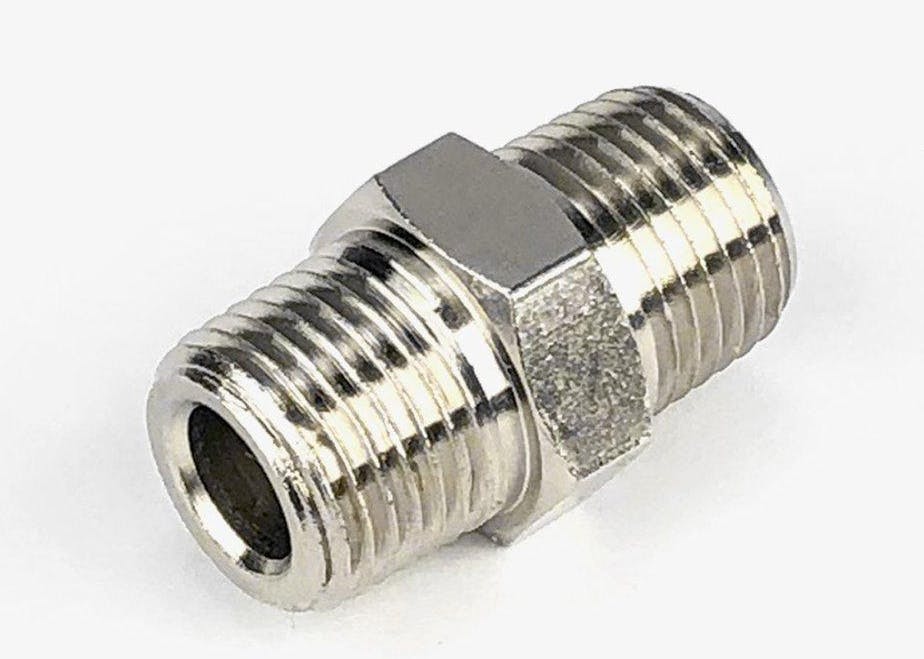
NPT or national pipe, or National Pipe Tapered, is an American standard defined under the AMSE B1.20.1. The standard outlines the dimensions and tolerances of tapered threads for pipes and fittings. Unlike straight threads, tapered threads give a more reliable seal, especially when used with a sealant material like Teflon tape. The standard is more than a hundred years old and was initially defined for plumbing applications; however, it has seen effective use in hydraulic and gas conveyance as well.
Characteristics of NPT Threads
NPT threads are defined by the following features:
- The taper angle is 1O 47’ (measured from the center axis of the NPT fitting)
- Flat crests and troughs
- 60O angle between each crest and trough
- The outer diameter of an NPT fitting is measured at the midpoint of the taper
- Pitch (the distance between threads) is measured in threads per inch (TPI)
Sizing in NPT threads
NPT defines both internal and external threads on fittings that conform to the standard; hence sizing charts give diameter measurements for both male and female parts. As a result, all male and female fitting types have consistency, adhering to the same taper rate – change in thread diameter per unit length. For the NPT standard, the taper rate is ¾ inch per foot or 1/16 inch per inch.
Since the O.D. is measured from the midpoint, confusion may arise when selecting the correct size fitting. An NPT fitting labeled as 1/8” has an actual outer diameter of 3/8”. So be careful when selecting NPT fittings, as you may end up using a fitting that’s too loose. The chart below summarizes the dimensions of some commonly used sizes. Note that some NPT fitting sizes have the same TPI; hence they can be used on each other on account of the taper.
Advantages of Using NPT Thread Fittings
Given that the standard has been around for a while, it has a set of advantages when being used. It is readily available in vendor inventories, with multiple sizes and materials to choose from. This allows you to use them for many applications at varying pressures. Moreover, they can be assembled in a simple manner as the metal-to-metal contact offers an excellent seal.
Disadvantages of Using NPT Thread Fittings
The metal-to-metal contact in NPT fittings relies on the deformation of the threads to form a secure seal. This, however, means that one cannot use them in applications that require frequent disassembly.
If used improperly, that is, without correct alignment, overtightening, or wrong sizing, ports may expand, and cracks may form on the threads. This, in turn, leads to the formation of leakage pathways from where the medium can leak out. It is for this reason that NPT fittings are not recommended for extremely high-pressure applications.
Frequently Asked Questions
What is the difference between NPT and BSP threads?
NPT (National Pipe Taper) and BSP (British Standard Pipe) are different thread standards used in industrial piping systems.
NPT threads have a 60-degree thread angle and are typically tapered. BSP threads have a 55-degree thread angle and are available in tapered (BSPT) and parallel (BSPP) configurations.
These differences affect thread engagement, sealing methods, and compatibility. Titan Fittings recommends identifying the correct standard before installing or replacing threaded components.
Can NPT and BSP fittings be connected together?
NPT and BSP fittings generally should not be connected directly because their thread angles, pitches, and profiles differ.
Although some sizes may appear similar and partially engage, mixing incompatible threads can result in leaks, damaged fittings, or connection failure.
Titan Fittings recommends using an appropriately rated NPT-to-BSP adapter when transitioning between thread standards.
How can you identify NPT versus BSP threads?
NPT and BSP threads can be identified by measuring thread diameter and pitch, checking whether the threads are tapered or parallel, and comparing their dimensions against recognized thread standards.
NPT threads use a 60-degree thread profile, while BSP threads use a 55-degree profile.
A thread pitch gauge, caliper, and reference chart are the most practical tools for identification. Because some thread sizes are very similar, Titan Fittings recommends verifying multiple dimensions rather than relying on appearance alone.
What is the difference between BSPT and BSPP threads?
BSPT (British Standard Pipe Taper) threads are tapered and typically use thread engagement with an appropriate sealant to create a pressure-tight connection.
BSPP (British Standard Pipe Parallel) threads have a constant diameter and generally rely on a sealing washer, O-ring, bonded seal, or another designed sealing surface.
Titan Fittings recommends confirming both the thread type and intended sealing method when choosing BSP fittings.
Do NPT and BSP threads require different sealing methods?
Yes. NPT threads commonly use a compatible thread sealant to fill the small gaps between engaged threads.
BSPT connections may also require thread sealant, while BSPP connections typically seal through a washer, O-ring, or dedicated sealing surface rather than the threads themselves.
Titan Fittings recommends using the sealing method specified for the connection and fluid service. Thread sealant should not be applied indiscriminately to every fitting type.
How can I tell whether a pipe fitting is NPT or BSP?
Start by measuring the fitting's thread diameter with a caliper and checking the thread pitch with a gauge. Next, determine whether the thread is tapered or parallel.
Compare these measurements against NPT and BSP thread charts to identify the correct standard. A visual inspection alone is not reliable because some sizes look nearly identical.
Titan Fittings offers thread identification resources to help customers verify compatibility before ordering replacement components.
How do I measure male and female pipe threads?
For male pipe threads, use a caliper to measure the outside thread diameter. For female pipe threads, measure the internal thread diameter at an accessible reference point.
Next, determine the threads per inch (TPI) or pitch using a thread gauge. For tapered threads, measurement location matters because the diameter changes along the thread.
Titan Fittings recommends comparing the measurements with an appropriate thread standard chart rather than assuming the measured diameter equals the nominal fitting size.
What is the difference between nominal pipe size and actual diameter?
Nominal Pipe Size (NPS) is a standardized designation used to identify pipe sizes. It does not always equal the actual inside or outside diameter.
For example, a nominal 1-inch pipe has a standardized outside diameter of 1.315 inches. Its inside diameter varies with wall thickness and pipe schedule.
Titan Fittings recommends checking nominal size, actual dimensions, and pipe schedule when choosing fittings, reducers, or adapters.
How do I determine the correct replacement pipe fitting?
To identify a replacement fitting, verify the existing fitting's connection type, thread standard, nominal size, material, and pressure rating.
Also check the system's operating temperature, fluid compatibility, and sealing requirements.
Titan Fittings recommends matching the complete fitting specification rather than relying on physical appearance or approximate thread engagement. This helps reduce leakage, installation problems, and premature component failure.
What tools are needed to measure pipe fittings accurately?
Common measurement tools include a digital or vernier caliper, thread pitch gauge, ruler, and pipe-thread identification chart.
For more demanding inspections, specialized thread gauges and calibrated measuring equipment may be necessary.
Titan Fittings recommends recording thread diameter, pitch, thread type, and nominal size before ordering replacement fittings.
More questions: Pipe Thread Identification, Sizing & Standards