What are the Use Cases for Quick Connect Couplings?
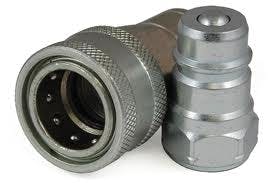
While there are many fluid and gas flow control applications that quick connect couplings, or quick connect fittings, are used for, the most common is quite possibly in water purification systems. However, no matter the nature of the application, if quick connect couplings are not connected properly, this could cause problems to your flow control system.
For this reason, it is crucial to understand how quick connect couplings work and how they are installed. This article will serve as a brief guide about quick connect couplings, outlining what they are, how they work, how they are installed, and what their benefits are.
What are Quick Connect Couplings?
As the name suggests, quick connect couplings, or quick connect fittings, are components that can be connected to the tubing in a fluid or gas flow control application quickly and easily. These components, first introduced in the 1970s, revolutionized the way fluid flow equipment was connected together. It is by far the fastest way of connecting tubing to a fluid flow application and provides a completely secure water-tight connection.
How do Quick Connect Couplings Work?
What makes these components so quick and easy to connect is their simple design. A quick-connect coupling comprises three individual components and one piece of tubing. The three components are: a collet, an O-ring, and the body. The tubing is to be inserted into the body, through first the collet, then through the O-ring, both of which are concealed by the body.
These three components work together to create a highly secure water-tight seal. As the pressure inside the tubing increases, the collet is forced into a groove on the inside of the fitting. Tiny teeth or ridges on the inside of the collet dig into the tubing and maintain the seal. The harder you pull on the tubing, the tighter the collet holds onto the tubing itself.
How to Install a Reusable Quick Connect Fitting?
The important thing to note when installing a reusable hydraulic quick connect fitting is that when inserting the tubing through the collet and O-ring, you must ensure that you push the tubing in all the way. If this is not done, the O-ring will not properly seal and the system will probably experience some leakages.
As mentioned, when you try to pull the tubing of a quick connect coupling out, the collet grips the tubing even harder and doesn’t let it go. Therefore, to detach the tubing from the rest of the quick coupling assembly, you must first pull the collet down towards the fitting, which will release its teeth from the inside of the tubing. The tubing should then be released and can be pulled right out.
Use Cases of Quick Connect Couplings
While water filtration and purification systems are the most common use case of quick connect couplings, these remarkable components also figure into other important fluid flow control applications and systems. This includes manufacturing industries that use heavy machinery as well as packaging industries where fluid flow control systems often prove necessary.
Transportation and automotive repair also require fluid lines, including the airbrake lines between trucks and trailers, which can be connected and disconnected using quick connect couplings. Lastly, these components are used in the medical industry, where equipment must be attached to a fluid line all while remaining sterile and leakproof.
Final Words
Quick connect couplings, or fittings, are remarkable components that are used in a large number of fluid flow control applications. These fittings make connecting and disconnecting easier and more convenient, all without compromising on the integrity and security of the water-tight seal.
Frequently Asked Questions
What is a quick disconnect connector, and how does it work in liquid cooling systems?
A quick disconnect connector is a coupling that allows coolant lines to be connected and disconnected quickly without requiring extensive system disassembly.
In data center liquid cooling, dry-break quick disconnects use internal shutoff valves to minimize coolant spills and air introduction when disconnected.
These connectors simplify server maintenance, equipment replacement, and cooling system upgrades while helping protect sensitive electronic components.
What is the difference between UQD and LQC quick disconnect connectors?
UQD (Universal Quick Disconnect) connectors are generally designed for smaller, server-level coolant connections inside data center racks. LQC (Large Quick Connector) couplings are intended for larger, higher-flow connections between cooling distribution equipment, manifolds, and rack supply lines.
UQDs typically support frequent manual connection and disconnection, while LQCs accommodate larger hose sizes and higher flow requirements.
Selecting the correct connector depends on installation location, coolant flow rate, operating pressure, and system design.
What is the UQD standard, and why is it important for data center liquid cooling?
The Universal Quick Disconnect (UQD) specification, developed through the Open Compute Project (OCP), defines common interface requirements for compatible quick disconnect couplings used in liquid-cooled data centers.
Standardized UQD connectors can improve interoperability between compliant components, simplify equipment maintenance, and reduce dependence on proprietary connection designs.
Customers should verify connector size, specification revision, pressure rating, and coolant compatibility before combining components from different manufacturers.
How do you choose the right quick disconnect connector for a data center cooling application?
Choosing the right quick disconnect connector requires evaluating coolant flow rate, allowable pressure drop, operating pressure, temperature, fluid compatibility, and connection location.
UQD connectors are commonly used for individual server connections, while LQC connectors are generally suited for higher-flow rack and distribution connections.
Customers should also consider coupling size, seal materials, connection frequency, and applicable OCP specifications to ensure reliable performance and system compatibility.
More questions: Quick Connectors