Why NPT, BSPP, and ORB Threads Are Not Interchangeable
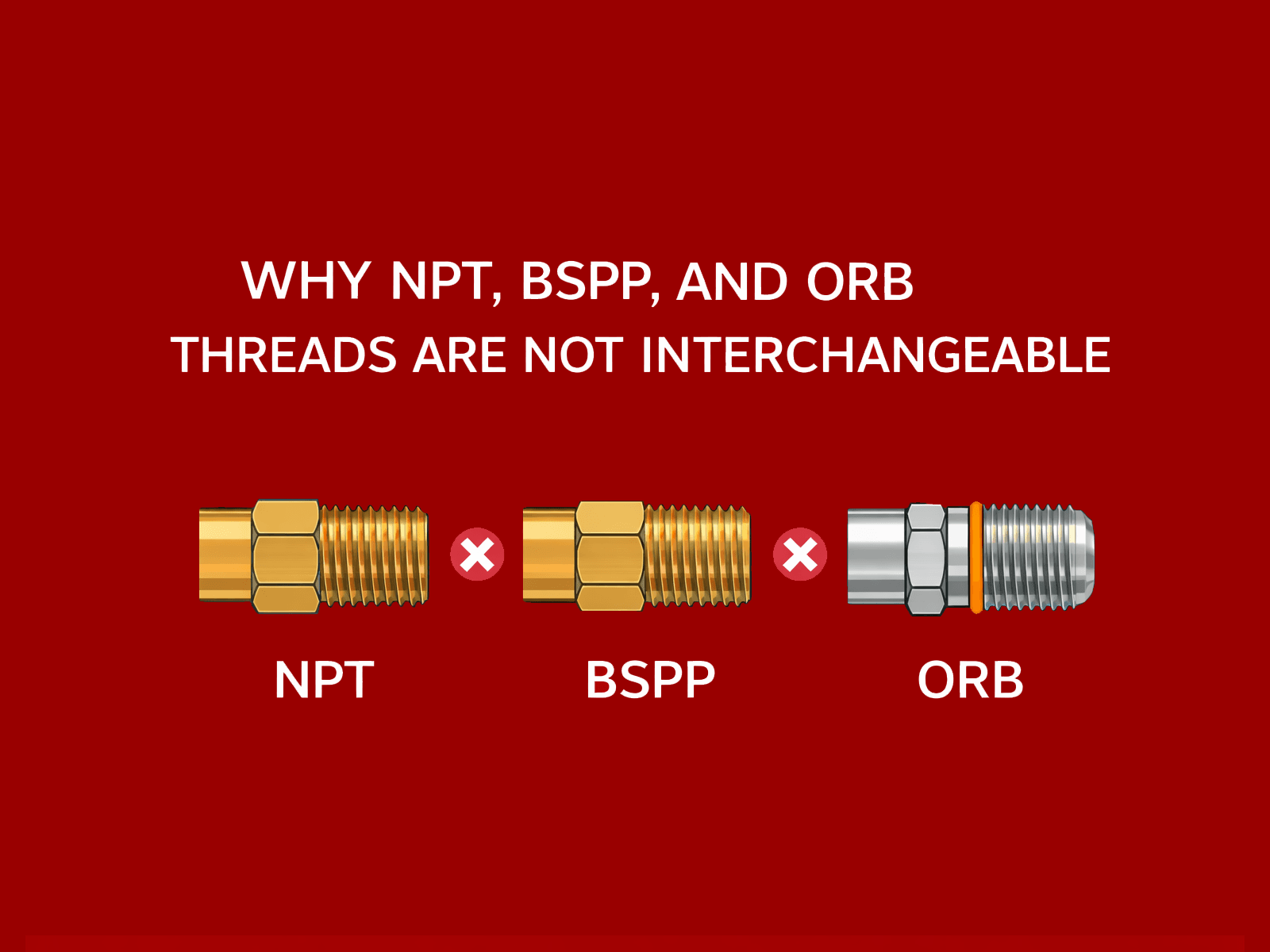
NPT, BSPP, and ORB threads may look similar at a glance, but they are built to completely different standards, which means they are not compatible with one another. NbacPT (Male Pipe Taper) threads are tapered, meaning the diameter becomes wider as the threads progress, allowing the seal to form through thread wedging and thread sealant.
In contrast, BSPP (British Standard Parallel Pipe) and ORB (O-Ring Boss) threads are parallel, which means the diameter does not taper at all. This alone creates a major difference in how they seal and how they are used in hydraulic systems.
- Shop NPT fittings: https://www.titanfittings.com/...
- Shop BSPP fittings: https://www.titanfittings.com/...
- Shop ORB fittings: https://www.titanfittings.com/...
Thread pitch is another critical difference. BSPP and ORB threads have specific pitches and profiles designed for their standards, while NPT uses a completely different pitch and thread angle. Because of this, attempting to thread an NPT male into a BSPP or ORB female will instantly cause resistance. This is where cross threading occurs, leading to damaged threads, leaks, and in many cases, the need to replace the fitting or even the port.
These thread types are not interchangeable, and any attempt to use one in place of another will permanently damage components. The safest approach is to identify the thread type correctly and select the proper adapter designed for that standard. Titan Fittings carries a full range of stainless steel and carbon steel MPT, BSPP, and ORB adapters to ensure every hydraulic connection is the right fit the first time. Explore all hydraulic thread types: https://www.titanfittings.com/...
Associated FAQs: Pipe Thread Identification
Frequently Asked Questions
What is the difference between NPT and BSP threads?
NPT (National Pipe Taper) and BSP (British Standard Pipe) are different thread standards used in industrial piping systems.
NPT threads have a 60-degree thread angle and are typically tapered. BSP threads have a 55-degree thread angle and are available in tapered (BSPT) and parallel (BSPP) configurations.
These differences affect thread engagement, sealing methods, and compatibility. Titan Fittings recommends identifying the correct standard before installing or replacing threaded components.
Can NPT and BSP fittings be connected together?
NPT and BSP fittings generally should not be connected directly because their thread angles, pitches, and profiles differ.
Although some sizes may appear similar and partially engage, mixing incompatible threads can result in leaks, damaged fittings, or connection failure.
Titan Fittings recommends using an appropriately rated NPT-to-BSP adapter when transitioning between thread standards.
How can you identify NPT versus BSP threads?
NPT and BSP threads can be identified by measuring thread diameter and pitch, checking whether the threads are tapered or parallel, and comparing their dimensions against recognized thread standards.
NPT threads use a 60-degree thread profile, while BSP threads use a 55-degree profile.
A thread pitch gauge, caliper, and reference chart are the most practical tools for identification. Because some thread sizes are very similar, Titan Fittings recommends verifying multiple dimensions rather than relying on appearance alone.
What is the difference between BSPT and BSPP threads?
BSPT (British Standard Pipe Taper) threads are tapered and typically use thread engagement with an appropriate sealant to create a pressure-tight connection.
BSPP (British Standard Pipe Parallel) threads have a constant diameter and generally rely on a sealing washer, O-ring, bonded seal, or another designed sealing surface.
Titan Fittings recommends confirming both the thread type and intended sealing method when choosing BSP fittings.
Do NPT and BSP threads require different sealing methods?
Yes. NPT threads commonly use a compatible thread sealant to fill the small gaps between engaged threads.
BSPT connections may also require thread sealant, while BSPP connections typically seal through a washer, O-ring, or dedicated sealing surface rather than the threads themselves.
Titan Fittings recommends using the sealing method specified for the connection and fluid service. Thread sealant should not be applied indiscriminately to every fitting type.
How can I tell whether a pipe fitting is NPT or BSP?
Start by measuring the fitting's thread diameter with a caliper and checking the thread pitch with a gauge. Next, determine whether the thread is tapered or parallel.
Compare these measurements against NPT and BSP thread charts to identify the correct standard. A visual inspection alone is not reliable because some sizes look nearly identical.
Titan Fittings offers thread identification resources to help customers verify compatibility before ordering replacement components.
How do I measure male and female pipe threads?
For male pipe threads, use a caliper to measure the outside thread diameter. For female pipe threads, measure the internal thread diameter at an accessible reference point.
Next, determine the threads per inch (TPI) or pitch using a thread gauge. For tapered threads, measurement location matters because the diameter changes along the thread.
Titan Fittings recommends comparing the measurements with an appropriate thread standard chart rather than assuming the measured diameter equals the nominal fitting size.
What is the difference between nominal pipe size and actual diameter?
Nominal Pipe Size (NPS) is a standardized designation used to identify pipe sizes. It does not always equal the actual inside or outside diameter.
For example, a nominal 1-inch pipe has a standardized outside diameter of 1.315 inches. Its inside diameter varies with wall thickness and pipe schedule.
Titan Fittings recommends checking nominal size, actual dimensions, and pipe schedule when choosing fittings, reducers, or adapters.
How do I determine the correct replacement pipe fitting?
To identify a replacement fitting, verify the existing fitting's connection type, thread standard, nominal size, material, and pressure rating.
Also check the system's operating temperature, fluid compatibility, and sealing requirements.
Titan Fittings recommends matching the complete fitting specification rather than relying on physical appearance or approximate thread engagement. This helps reduce leakage, installation problems, and premature component failure.
What tools are needed to measure pipe fittings accurately?
Common measurement tools include a digital or vernier caliper, thread pitch gauge, ruler, and pipe-thread identification chart.
For more demanding inspections, specialized thread gauges and calibrated measuring equipment may be necessary.
Titan Fittings recommends recording thread diameter, pitch, thread type, and nominal size before ordering replacement fittings.
More questions: Pipe Thread Identification, Sizing & Standards