What Fittings Does a Data Center Liquid Cooling System Actually Need?
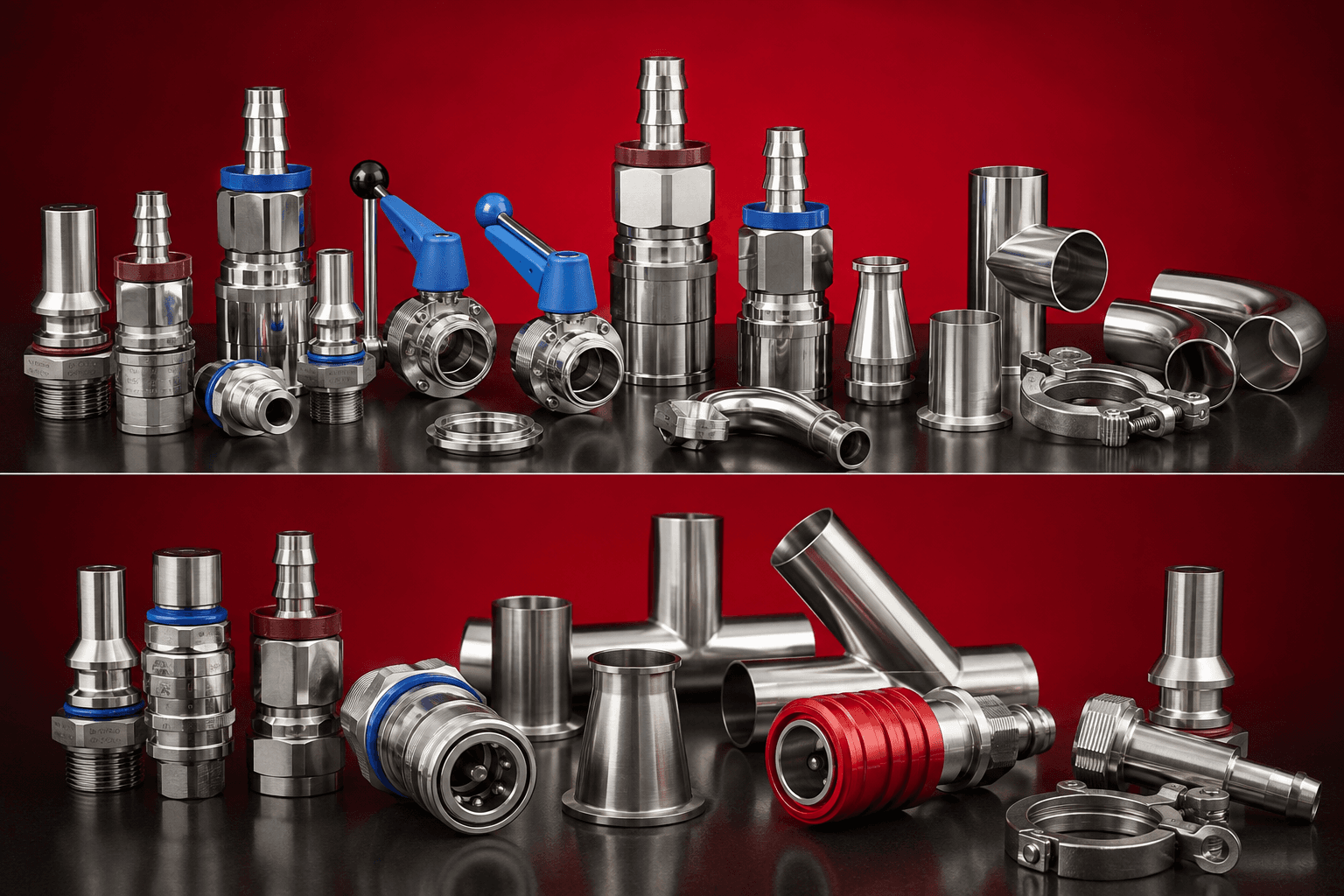
AI and high-density compute have pushed rack power past the point where moving air can carry the heat away. A single rack of GPUs can now draw more power than an entire row did a few years ago, and the industry's answer is to bring liquid directly to the heat. That shift has quietly turned the data center into a fluid-handling facility — one where the coolant runs inches from millions of dollars of electronics, and where a single weeping connection can take a compute node offline.
A liquid cooling loop is only as reliable as the connections that hold it together. This guide walks the entire loop, from the facility water main to the chip, and names the fittings, valves, hoses, and couplings that live at each stage — with particular attention to the connections between the distribution headers and the rack, where most of the field-assembled joints actually are.
Two loops and the boundary between them
Almost every liquid-cooled facility runs two separate fluid loops that never mix.
The facility water system (FWS), or primary loop, carries facility water or a water-glycol blend from the central plant — chillers, cooling towers, or dry coolers — through large-diameter piping out to the white space. Its job is heat rejection, and because its chemistry is managed at the plant rather than at the rack, it tolerates harder materials and larger, more conventional plumbing.
The technology cooling system (TCS), or secondary loop, is the clean side. It circulates a controlled coolant — commonly propylene glycol blends such as PG25, deionized water, or a water-glycol mix — through the racks and across the cold plates. Everything on this side has to stay clean and corrosion-free, because whatever the fluid picks up eventually reaches a cold plate machined with sub-millimeter passages.
Sitting between the two is the coolant distribution unit (CDU). It houses a heat exchanger that transfers heat from the TCS to the FWS without letting the fluids touch, along with pumps, filtration, and controls. The CDU is the handoff point, and it is also where the connection count starts to climb.
The facility side: large piping and isolation
On the primary loop, the fittings are big and comparatively conventional: 4-inch-and-larger stainless piping, reducers and tees routing supply and return, and isolation valves that let crews take a CDU or a branch out of service without draining the plant. Reliability is non-negotiable here — an FWS failure cascades straight into a thermal event — but the fluid chemistry is controlled, so the emphasis is on robust, leak-tight joints and clean isolation points rather than exotic materials.
The secondary fluid network: row headers and rack drops
This is where a data center's connection count really lives, and where the components you specify matter most.
From each CDU, the secondary fluid network extends through row-level manifolds — supply and return headers that run overhead or under the floor along the row of racks. These headers are typically 4-inch, 6-inch, or 8-inch stainless, with 4-inch being the most common. Each header carries standardized take-off points, and at every rack the loop makes a rack drop: the branch connection that brings supply and return from the header down to the rack itself.
A single rack drop is a short sequence of components, and each one earns its place:
- A transition fitting steps the connection down from the large header to the smaller line feeding the rack, and adapts between thread and connection standards where the header, the valve, and the hose don't share one.
- An isolation ball valve lets a technician shut off flow to one rack for service or emergency work without draining or depressurizing the rest of the loop. Full-port valves keep the pressure drop low across a run that may feed dozens of racks.
- A flexible hose connection absorbs the misalignment, thermal movement, and vibration between a rigid header and a rack that was never positioned to the millimeter. It also makes the final connection something a crew can actually make by hand in a tight aisle.
- A dripless quick disconnect completes the drop at the rack boundary, so racks can be connected and disconnected without spilling coolant near live hardware.
For that last connection, the Open Compute Project defines the LQC (Large Quick Connector) — a standard originally initiated by Meta for exactly this part of the loop. The LQC is a screw-to-connect, high-flow, dripless coupling built for the facility-to-rack and CDU-to-manifold connection, rather than the smaller server-level interface. The 1-inch LQC is the common choice for rack drops fed from a 4-inch header, and it can be connected and disconnected under working pressure — the reason it wins over push-to-connect couplings where crews service running systems.
Because these joints are field-assembled in the thousands during a fast build, and because they sit on the clean side of the loop directly above the racks, this is the zone where fitting quality shows up first in commissioning and last in the maintenance log.
Inside the rack: manifolds, couplings, and cold plates
Past the rack drop, the coolant enters an in-rack manifold — usually a vertical, zero-U bar that distributes supply and return to each server or node. From there, short lines run to each cold plate, and the connection at the server is typically a UQD (Universal Quick Disconnect) — the OCP's hand-mate, spill-free coupling sized for the server and cold-plate interface. Inside the node, the coolant runs through a cold plate sitting directly on the CPU or GPU, then returns.
This on-rack zone is real, and it is heavily standardized around the UQD. But it is also the most crowded and commoditized part of the loop. The larger, off-rack connections — the rack drop and the header and CDU side — are where a fitting supplier's material and machining choices make the clearest difference to a mechanical contractor building out the secondary network.
Why stainless steel, throughout
Two grades cover almost everything a cooling loop needs. 304 stainless handles most structural and distribution duty at lower cost, while 316L adds molybdenum for extra corrosion resistance and a low carbon content that suits the clean, welded, sometimes deionized-water service on the TCS side. Deionized water in particular is aggressive toward the wrong metals, and glycol blends demand seal and fitting materials that won't degrade over a ten-year service life. Stainless answers both — which is why it has displaced brass and plastic as the default across CDUs, manifolds, and rack-level connections.
Materials also have to agree with each other. Where stainless fittings meet copper cold plates, dissimilar-metal contact in a shared fluid path can drive galvanic corrosion, so the whole loop has to be considered as one system rather than a bag of parts.
Where Titan fits
Titan is a single-source solution provider for the connections these systems depend on — the adapters, fittings, quick disconnects, and valves you have to spec. And because Titan manufactures in the US, it turns orders around with one of the fastest lead times in the industry: weeks, not months.
Titan Fittings supplies the stainless steel components that make up the off-rack side of the loop: transition fittings, isolation ball valves, flexible hose connections, and 1-inch OCP LQC quick disconnects — the connections that take coolant from a 4-, 6-, or 8-inch header down to the rack. Everything is 304 and 316L stainless, rated well above the roughly 125 psi these loops run, and compatible with PG25, deionized water, and the full range of cooling fluids in use today. We work with the hyperscalers, mechanical contractors, and colocation providers building and servicing these systems, and we supply the in-rack fittings and quick disconnects as well when a project needs the full path covered.
If you're specifying the secondary fluid network for a liquid-cooled build or retrofit, talk to us about your rack-drop connections — or read on for a closer look at the rack drop itself and choosing between 304 and 316L for coolant service.