The Rack Drop: Connecting a Cooling Header to the Rack
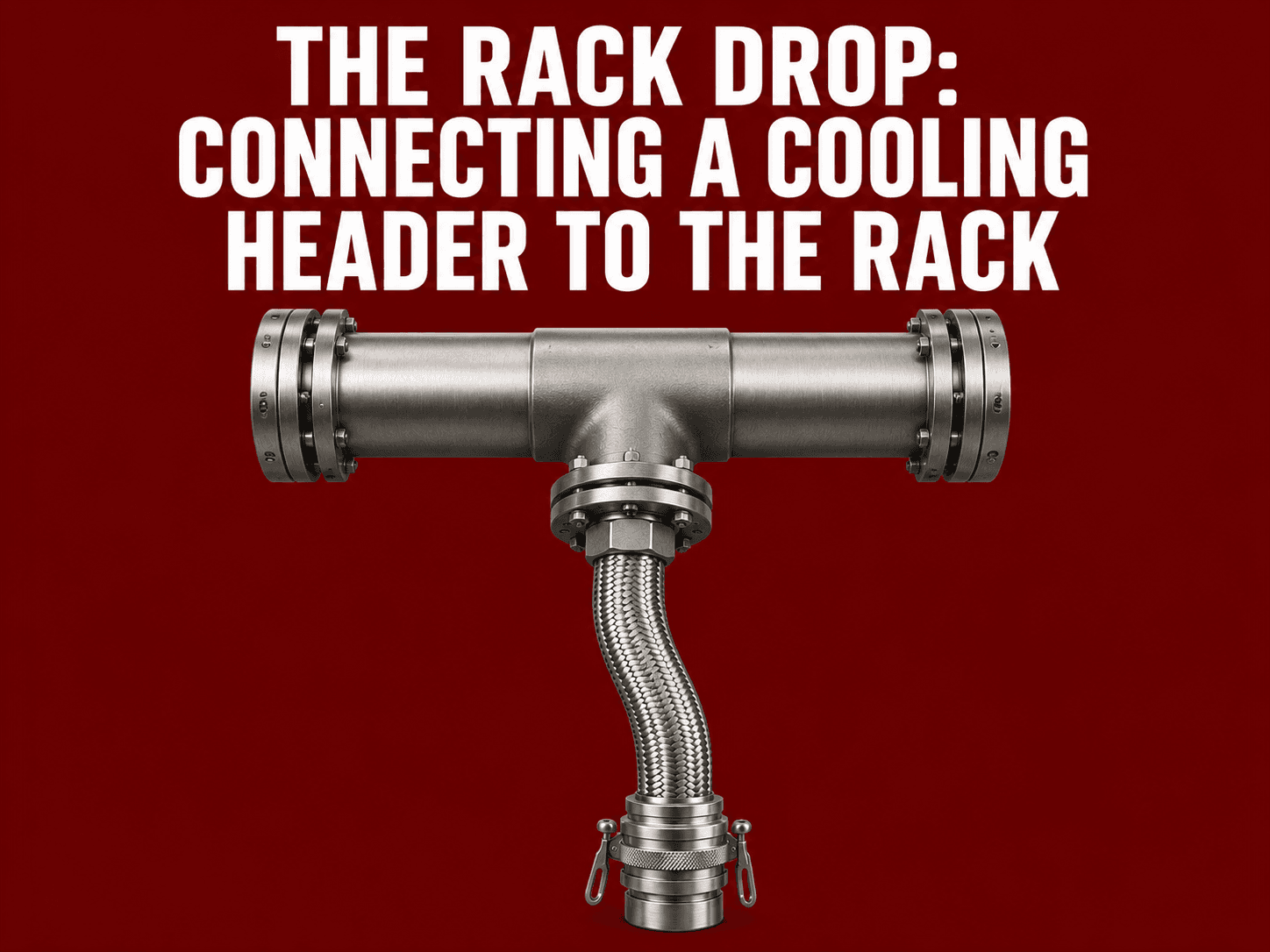
In a liquid-cooled data center, the connection made most often isn't at the chip. It's at the rack drop — the branch that takes coolant from a distribution header down to an individual rack. A single hall can have hundreds of them, each one assembled by hand in the field, each sitting on the clean side of the loop directly above live hardware. It's also the connection most likely to be treated as an afterthought, specified as a bag of parts rather than as one engineered joint.
This article breaks the rack drop down component by component, in the order coolant flows through it, and explains why each piece is there and what happens when it's chosen badly.
Where the rack drop sits
Work back from the rack and the path is short. A coolant distribution unit (CDU) feeds a secondary fluid network — supply and return headers that run overhead or under the floor along each row of racks. These headers are typically 4-inch, 6-inch, or 8-inch stainless, with 4-inch the most common. At every rack, the loop taps off both the supply and return headers and drops down to the rack: that pair of branches is the rack drop.
Because it's on the technology cooling loop — the clean side that runs PG25, deionized water, or a water-glycol blend straight to the cold plates — everything in the drop has to stay leak-tight and corrosion-free. And because racks get serviced, swapped, and added over a facility's life, the drop has to be something a technician can isolate, disconnect, and remake without draining the row or dripping coolant onto electronics.
The anatomy of a rack drop, in order
A well-built drop is a short sequence, and the order isn't arbitrary. Reading from the header toward the rack:
1. The transition fitting. The tap off a 4-, 6-, or 8-inch header has to step down to the much smaller line feeding the rack, and it usually has to adapt between connection or thread standards at the same time — the header, the valve, and the hose rarely all share one. This is the transition fitting's job: reduce the size and reconcile the standards in as few joints as possible, because every joint is a potential leak path. In stainless, machined clean, it sets up everything downstream.
2. The isolation ball valve. Immediately after the transition, each leg of the drop gets a valve. This is what lets a technician take one rack out of service — for a planned swap or an emergency — without draining or depressurizing the rest of the loop. Put a valve on both supply and return and the rack isolates completely; leave one off and you can't safely open the rack. Full-port valves matter here: a header may feed dozens of racks, and a restriction at every drop adds up to real pressure drop across the run.
3. The flexible hose. A rigid header and a rack were never positioned to the millimeter, and the two move independently as the loop heats and cools. A flexible hose absorbs that misalignment, thermal growth, and low-level vibration instead of transmitting it into the fittings as fatigue. Just as important, it makes the final connection something a crew can actually make by hand in a crowded aisle — no fighting hard pipe into alignment behind a rack.
4. The dripless quick disconnect. At the rack boundary, a dripless coupling completes the drop. This is the connection that gets made and broken over the facility's life, so it has to seal on both halves the instant it separates — no spill, no air ingress, no coolant on the hardware below. For this part of the loop, the Open Compute Project defines the LQC (Large Quick Connector), a standard originally initiated by Meta specifically for the facility-to-rack and CDU-to-manifold connection.
Why the isolation valve is non-negotiable
It's tempting to see the valve as optional on a drop that already has a quick disconnect. It isn't. The quick disconnect seals a line that's already been shut off; the valve is what shuts it off. Without an isolation valve on each leg, disconnecting a rack means either draining down the section of loop that feeds it or breaking a coupling on a live, pressurized line — the first is slow and messy, the second risks a spill right where you can least afford one.
Isolation valves are also what make the loop serviceable at commissioning. New sections get flushed and filled through them; suspect racks get valved out while the rest of the row keeps running. In a facility designed for N+1 and continuous duty, per-rack isolation is the difference between a five-minute swap and a scheduled outage.
Why flexible hose instead of hard pipe
Hard-lining the last stretch to the rack looks tidy and saves a component, but it assumes the header and the rack will hold a fixed relationship forever. They won't. Thermal cycling moves both. Racks get nudged during service. Pumps put a low hum into the system. Rigid pipe carries all of that into the nearest fitting as stress, and the nearest fitting is usually the one over your servers.
A flexible hose decouples the two ends, tolerates the alignment reality of a field build, and turns the final connection into a hand-mate operation. The trade-offs — bend radius, proper support, and matching the hose construction to the coolant — are real and worth designing for, but they're easier to manage than the fatigue and service headaches of a hard-lined drop. (We cover the hose selection in more depth in a companion article.)
Choosing the coupling: LQC at the drop, UQD at the server
Not every quick disconnect belongs in every spot. Two OCP families divide the work.
The UQD (Universal Quick Disconnect) is the hand-mate, spill-free coupling sized for the server and cold-plate interface — the in-rack connections. The LQC (Large Quick Connector) is the larger, higher-flow coupling built for the facility-to-rack and CDU-to-manifold connection, where the rack drop lives. Its screw-to-connect mechanism is the key detail: it lets a technician connect and disconnect under working pressure, which is exactly what you want when you're servicing a running system rather than a drained one. The 1-inch LQC is the common choice on a drop fed from a 4-inch header.
Put simply: reach for the LQC where the loop meets the rack, and the UQD where the rack meets the server. Matching the coupling to its zone keeps flow up and spill risk down.
The details that decide whether it leaks
A rack drop is only as good as its worst joint, and a few details separate a clean commissioning from a punch list:
- Keep the fluid path off the power path. Route the drop so a weep can't reach cabling or busway, and back it up with drip protection — drip pans under drops are industry best practice for a reason.
- Match the metals. Where stainless meets a copper cold plate downstream, dissimilar metals in a shared fluid path can drive galvanic corrosion. Consider the drop as part of the whole loop, not in isolation.
- Mind the coolant. Deionized water is aggressive toward the wrong materials, and glycol blends demand seals and fittings that survive a decade of service. This is why the whole drop is built in stainless.
Materials: 304 and 316L
Two grades cover the drop. 304 stainless carries most of the distribution and structural duty at lower cost, while 316L adds corrosion resistance and a low carbon content suited to the clean, sometimes deionized-water service on the technology cooling loop. Neither introduces the corrosion and compatibility problems that pushed brass and plastic out of the coolant path in the first place. (For a full comparison, see our 304-versus-316L article.)
Where Titan fits
Titan is a single-source solution provider for the connections these systems depend on — the adapters, fittings, quick disconnects, and valves you have to spec. And because Titan manufactures in the US, it turns orders around with one of the fastest lead times in the industry: weeks, not months.
Titan Fittings builds the rack drop: stainless transition fittings, full-port isolation ball valves, flexible hose connections, and 1-inch OCP LQC quick disconnects, all in 304 and 316L, all compatible with PG25, deionized water, and the coolants these loops run. We supply the hyperscalers, mechanical contractors, and colocation providers assembling and servicing these connections at scale.
Send us your header size and drop count and we'll help you spec the connection — or read the full-loop overview to see where the rack drop fits in the larger system, and the deeper dives on isolation ball valves, flexible hose selection, and LQC couplings.