Why Every Rack Drop Needs an Isolation Ball Valve
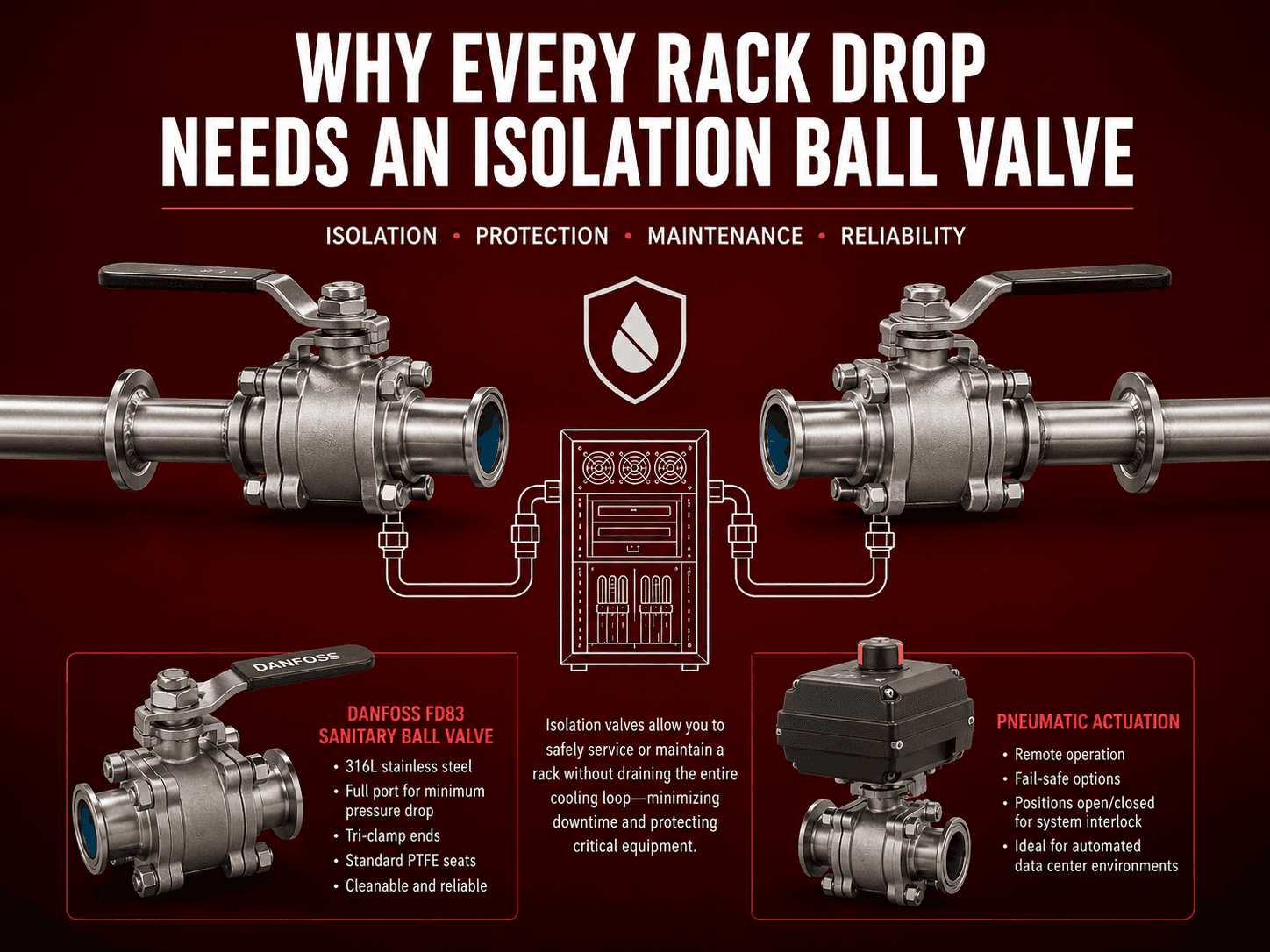
It's the cheapest component on a rack drop, and the one most likely to get value-engineered out of an early design. That's a mistake. The isolation ball valve is what turns a rack from a permanent part of the loop into something a technician can take on and off line in minutes — without draining the row, without breaking a live connection, and without risking a spill over live hardware. Leave it out and every future service call gets slower and riskier.
Here's what the valve actually does, why a ball valve is the right type, and the details that separate a valve you can rely on for a decade from one that seizes or seeps.
What the valve does
The technology cooling loop is a continuous circuit: coolant leaves the CDU, runs the supply header, drops into each rack, returns through the return header, and goes back to the CDU. Tap into that circuit to service one rack and, without isolation, you're opening a pressurized loop that feeds everything else on the header.
An isolation valve on each leg of the drop — supply and return — closes that rack off from the live loop so it can be worked on in isolation. The emphasis on each leg matters: valve only the supply and coolant still backs up through the return; valve both and the rack is fully sealed off, ready to disconnect. It's the step that has to happen before the quick disconnect is ever broken.
Why a ball valve specifically
Several valve types can isolate a line. For a rack drop, the ball valve wins on the things that matter here:
- Positive, bubble-tight shutoff. A quarter turn seats the ball against its seals for a definite open or closed — no partial states, no guessing. On the clean loop above live hardware, "mostly closed" isn't good enough.
- Low pressure drop when full-port. A full-port ball valve leaves a bore close to the line's full diameter, so an open valve barely registers as a restriction. That's important when a single header feeds dozens of drops and every restriction compounds into pressure the pumps have to overcome.
- Fast, obvious operation. A quarter-turn lever is quick to throw in a tight aisle, and the handle position shows the valve's state at a glance — closed is closed, and anyone can see it.
- Compact and durable. Few moving parts, a small envelope, and a long service life under continuous duty suit a component that has to sit untouched for months and then work perfectly on demand.
By contrast, throttling valves add restriction and invite partial-open ambiguity, and slower multi-turn valves cost time on every service. For pure isolation, the quarter-turn ball valve is the clean answer.
Full-port versus standard-port
The distinction is worth calling out because it's easy to spec past. A standard-port valve necks the flow path down through the valve body; a full-port valve keeps it open. Across one drop the difference is small. Across a header serving dozens of racks, the accumulated pressure drop from necked-down valves is real pumping energy — and pumping energy runs 24/7 for the life of the facility. For rack-drop isolation, full-port is usually the right default.
What it buys you at commissioning and in service
The valve earns its place long before the first failure. At commissioning, new sections get flushed and filled through their isolation valves rather than through the whole loop. In operation, a suspect rack gets valved out while the rest of the row keeps running — the practical meaning of designing for N+1 and continuous duty. When a rack is swapped or upgraded, isolation turns a potential outage into a routine hot swap. Every one of those is faster and safer because the valve was there.
The details that decide reliability
- Material. In 304 or 316L stainless, the valve matches the rest of the drop and the coolant — no brass in the path, no galvanic surprises, and 316L where the cleaner deionized-water service calls for extra corrosion resistance.
- Seat integrity over cycles. A valve that seals on day one but weeps after a hundred cycles is worse than useless on the clean loop. Seat and seal quality is what you're really buying.
- Placement. The valve belongs upstream of the quick disconnect on each leg, so the line is dead before the coupling is broken. Where the design calls for it, a small drain or vent point downstream lets the isolated section be emptied cleanly.
- End connections. Matching the valve's connections to the transition fitting and hose on either side keeps the joint count — and the leak paths — to a minimum.
Where Titan fits
Titan is a single-source solution provider for the connections these systems depend on — the adapters, fittings, quick disconnects, and valves you have to spec. And because Titan manufactures in the US, it turns orders around with one of the fastest lead times in the industry: weeks, not months.
Titan Fittings supplies full-port isolation ball valves in 304 and 316L stainless, sized for rack drops and built for the PG25, deionized water, and glycol coolants these loops run. They're part of the same rack-drop package as our transition fittings, flexible hose connections, and 1-inch OCP LQC quick disconnects — one source for the whole connection.
Send us your drop count and header size and we'll help you spec the isolation. For the full picture, see how the rack drop goes together and where it sits in the larger loop