LQC Quick Disconnects vs In-Rack UQDs: Choosing the Right Coupling for Each Zone
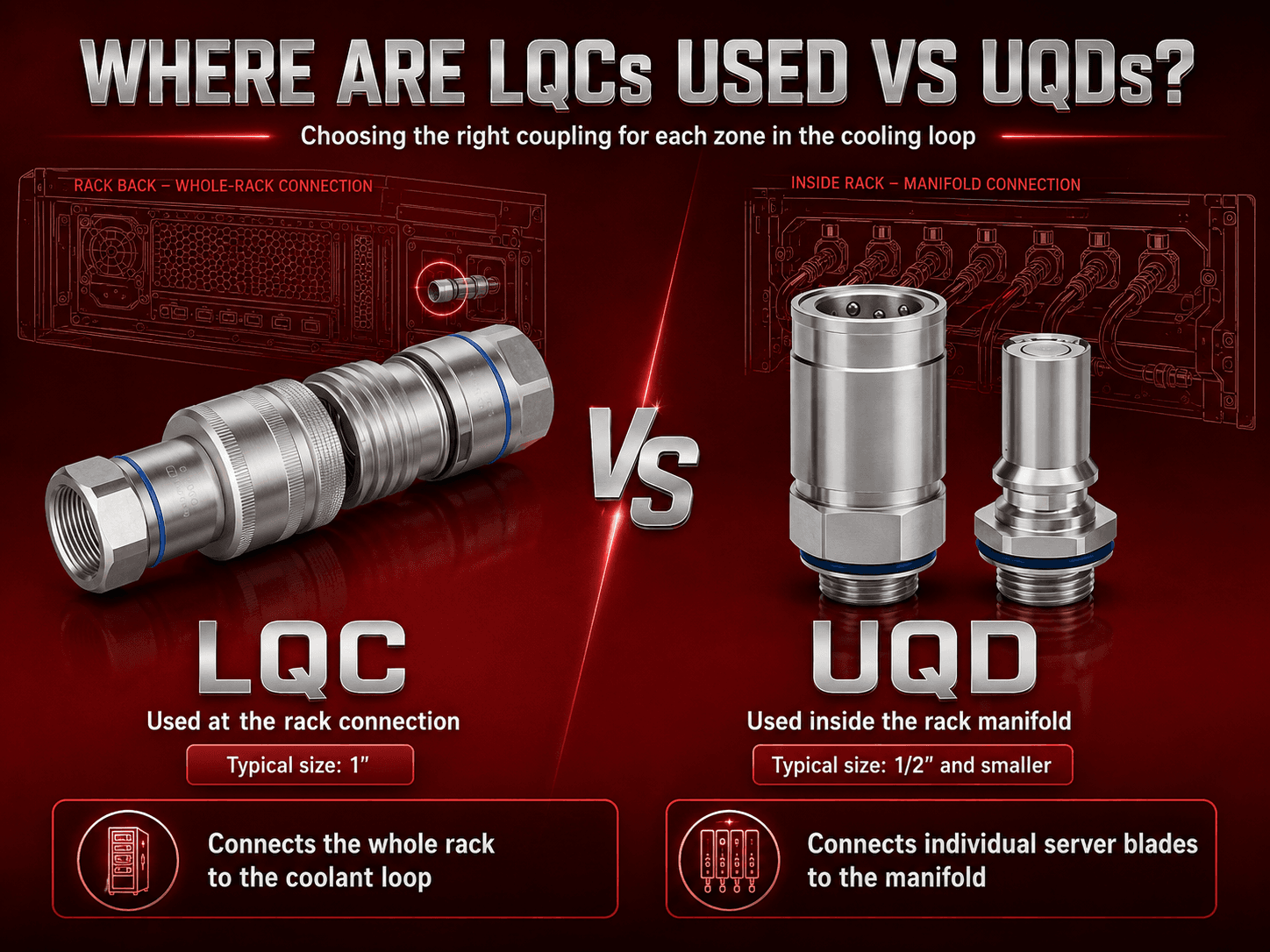
Both are dripless. Both are Open Compute Project standards. Both let a connection be made and broken without spilling coolant near live hardware. So it's easy to assume a quick disconnect is a quick disconnect and reach for whatever's on the shelf. It isn't. The LQC and the UQD were designed for different parts of the loop, and putting the wrong one in a spot either chokes your flow or slows every service call. This article draws the line between them and explains which belongs where.
First, what OCP standardization buys you
Before the differences, the thing they share. Both the LQC and the UQD are couplings defined by the Open Compute Project, which means the interface — the dimensions, the sealing, the mating — is specified openly rather than owned by one manufacturer. Any compliant vendor's half connects to any other compliant vendor's half. For a facility, that's real leverage: second sources, no single-vendor lock-in on a component you'll buy by the thousand, and one connection standard across a fleet instead of a patchwork. Choosing an OCP coupling is partly a supply-chain decision, not just a mechanical one.
With that established, the two standards split the loop between them.
The UQD: at the server, inside the rack
The UQD (Universal Quick Disconnect) is an Intel-initiated OCP standard built for the in-rack connections — the interface between the rack manifold and the servers, down at the cold plate. It's a hand-mate, latching coupling, often described as one-hand-operated: a technician can connect or disconnect a server by hand, quickly, without tools. Its dry-break valves seal both halves the instant they separate, so a server can be hot-swapped out of a running rack with no spill and no air pulled into the loop.
That profile — fast, hand-mate, spill-free — is exactly right for the connection that gets made and broken the most. Servers are the things that come and go over a rack's life, and the UQD is sized and shaped for that high-frequency, node-level service. It comes in a range of sizes (the UQD02 through UQD08 family) matched to the smaller flows of individual server branches.
The LQC: at the rack drop and the CDU
The LQC (Large Quick Connector) is a different animal for a different job. Originally initiated by Meta and defined within OCP, it's built for the larger, higher-flow connections on the facility side of the loop — the rack drop, and the CDU-to-manifold trunk. Where the UQD serves a server branch, the LQC carries a whole rack's or manifold's worth of flow.
Two things set it apart. First, it's high-flow — a larger bore sized for trunk-level volume rather than a single node. Second, and more telling, it uses a screw-to-connect mechanism rather than a hand-mate latch. That screw action lets the LQC be connected and disconnected under working pressure, which is precisely what you want on a trunk line you're servicing without draining the loop — the connection stays positively secured under flow and pressure that would be a lot to hand-mate against. Redundant sealing backs up the dripless performance on a connection sitting above the racks.
The 1-inch LQC is the common choice at a rack drop fed from a 4-inch header — big enough for the row-to-rack flow, and the right interface where the secondary network meets the rack.
Why the mechanism differs — and why it matters
The hand-mate-versus-screw-to-connect distinction isn't arbitrary; it follows the job.
A server gets serviced often and carries a modest branch flow, so the UQD optimizes for speed and one-handed convenience — throw it on, throw it off, move to the next node. A rack drop or CDU trunk carries far more flow and is connected under pressure during live service, so the LQC optimizes for a secure, positive engagement that holds against that pressure. Fast-and-frequent at the server; secure-and-high-flow at the trunk. Each mechanism is tuned to what its zone actually demands.
Why you can't just use one everywhere
It's tempting to standardize on a single coupling to simplify purchasing. In practice it backfires either direction.
Put a small server-class UQD on a rack drop or trunk and you've necked the flow path down at exactly the point that has to carry the most volume — a bottleneck that shows up as pressure drop the pumps have to fight and cooling the rack can't get. Go the other way and fit a large screw-to-connect LQC at every server, and you've made the most frequent connection in the building slow, bulky, and awkward to reach in a packed rack. The couplings aren't interchangeable because the connections aren't. Matching each to its zone is what keeps flow up where it matters and service fast where that matters.
A note on blind-mate variants
For completeness: some in-rack server interfaces use blind-mate couplings — the UQDB (a blind-mate UQD) and the BMQC defined for blind-mate rack architectures — where a sled has to connect as it's pushed into position, with the coupling absorbing the misalignment. These live in the same in-rack, server-level zone as the UQD, just for designs that mate blind rather than by hand. They don't change the basic split: server-level couplings inside the rack, LQC-class couplings where the loop meets the rack and the CDU.
The rule of thumb
Reach for the LQC where the loop meets the rack — the rack drop and the CDU-to-manifold trunk. Reach for the UQD where the rack meets the server — the in-rack, cold-plate connections. Keep each coupling in its zone and the loop flows freely, services quickly, and stays dripless throughout.
Where Titan fits
Titan is a single-source solution provider for the connections these systems depend on — the adapters, fittings, quick disconnects, and valves you have to spec. And because Titan manufactures in the US, it turns orders around with one of the fastest lead times in the industry: weeks, not months.
Titan Fittings focuses on the off-rack side, where we supply 1-inch OCP LQC quick disconnects as part of the complete rack drop — alongside our transition fittings, isolation ball valves, and flexible hose connections, all in 304 and 316L stainless and compatible with PG25, deionized water, and the coolants these loops run. Because the LQC is an open OCP standard, our couplings interoperate with other compliant halves across your fleet. When a project needs the in-rack path covered too, we supply that side as well.
Tell us your header size and drop count and we'll help you spec the couplings. For how the LQC fits the rest of the connection, see the rack drop, component by component; for the in-rack side, see our in-rack fittings; and for the whole system, the full-loop overview