A Guide to Quick Disconnects and the UQD Standard
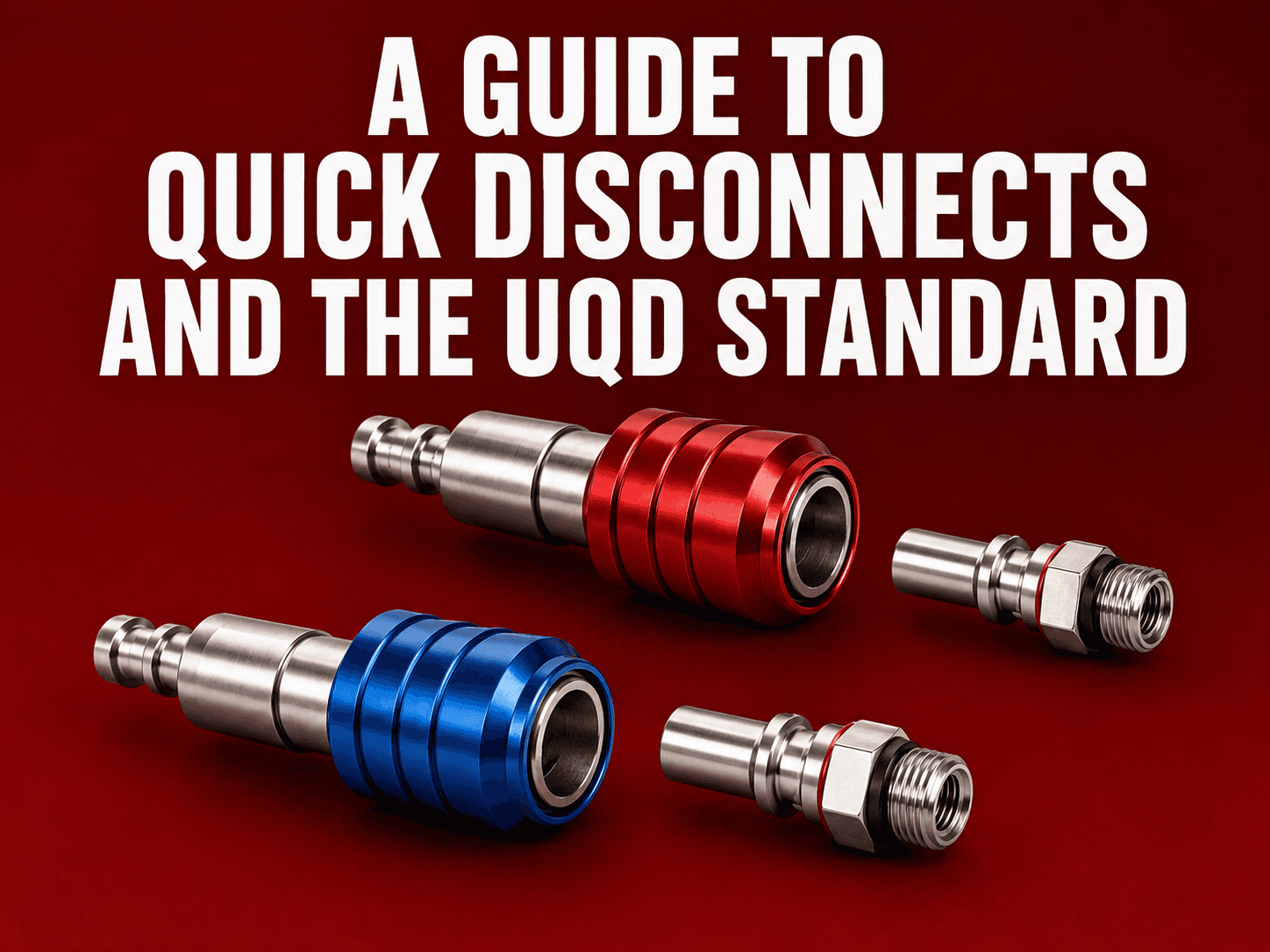
As liquid cooling scaled into mainstream data centers, it created a problem the industry had to solve fast: how do you connect and disconnect servers from a pressurized coolant loop — routinely, by the thousands — without spilling fluid on live hardware, shutting down the rack, or locking yourself into a single vendor's hardware? The answer was a family of standardized, dripless quick disconnects, anchored by the UQD. This guide explains what they are, how they differ, and where each belongs.
Why quick disconnects matter in a cooling loop
In an air-cooled world, pulling a server is trivial. In a liquid-cooled rack, that same server has coolant running through it, and the connection to the loop has to come apart cleanly. Quick disconnects make that possible in three ways:
- Serviceability. A technician can disconnect and swap a server by hand, without tools and without draining the loop.
- Spill-free protection. A dry-break coupling seals both halves the instant it separates, so no coolant escapes onto the electronics below and no air gets pulled into the loop.
- Modularity. Standardized couplings let racks and rows scale, expand, and get reconfigured without redesigning the connection each time.
Together, those turn a liquid-cooled rack from a fragile, all-or-nothing system into something that can be maintained one node at a time.
What OCP standardization buys you
Most of these couplings are defined by the Open Compute Project (OCP), and that matters as much as any mechanical feature. An OCP coupling has an openly specified interface — dimensions, sealing, and mating defined in a public standard rather than owned by one manufacturer — so any compliant vendor's half connects to any other's.
For a facility buying couplings by the thousand, that interoperability is leverage: second sources, no single-vendor lock-in, and one connection standard across a whole fleet instead of a patchwork of proprietary parts. Choosing an OCP-standard coupling is a supply-chain decision as much as an engineering one.
The UQD: the core standard
The UQD (Universal Quick Disconnect) is the anchor of the family — an OCP standard originating from an Intel initiative, built for the in-rack connections between the rack manifold and the servers. Its defining traits:
- Hand-mate and latching. Often described as one-hand-operated, it connects and disconnects by hand, quickly, without tools — right for the connection that gets made and broken the most.
- Spill-free, dry-break. Bidirectional valves seal both halves on separation, so servers hot-swap out of a running rack with no spill and no air ingress.
- Sized in a family. The UQD02 through UQD08 sizes match the flows of individual server branches.
- Simple hose termination. A push-lock hose connection secures the hose without clamps or crimped ferrules.
If you picture the connection where a rack manifold meets a server, that's UQD territory.
The blind-mate variants
Some rack architectures don't connect by hand — a server sled makes its fluid connection automatically as it's pushed into position, which means the coupling has to tolerate the misalignment of a blind mate. Two variants handle that:
- UQDB— a blind-mate version of the UQD, built to connect with a small misalignment tolerance.
- BMQC (Blind-Mate Quick Connector) — defined for blind-mate rack architectures, where the sled-to-manifold connection has to absorb more radial and angular misalignment as it seats.
Pivoting and self-centering designs from various vendors address the same challenge. All of them live in the same in-rack, server-level zone as the UQD — they just mate blind instead of by hand.
The LQC: the large cousin, off-rack
Not every connection is at the server. The LQC (Large Quick Connector)— an OCP standard originally initiated by Meta — is the larger, higher-flow coupling for the facility side of the loop: the rack drop and the CDU-to-manifold trunk. It uses a screw-to-connect mechanism that lets it be connected under working pressure, which suits a trunk line serviced without draining the loop.
The simple way to hold the whole family in your head: UQD-class couplings inside the rack, at the server; LQC-class couplings off the rack, where the loop meets the rack and the CDU. We compare the two directly in LQC Quick Disconnects vs In-Rack UQDs.
A maturing standard
These standards are still evolving as liquid cooling scales — later revisions have improved flow, tightened geometry, and standardized testing across the family. That churn is a sign of a healthy, active ecosystem, but it also means interoperability claims are worth confirming against the current revision when you specify.
How to choose
A few practical pointers when specifying quick disconnects:
- Match size to flow. Use the coupling sized for the branch it serves — a server-class UQD on a trunk chokes flow; an oversized coupling at a node wastes space.
- Match the mate to the architecture. Hand-mate where technicians connect by hand; blind-mate where sleds seat automatically.
- Confirm OCP compliance and revision for the cross-vendor interoperability you're counting on.
- Check the materials. Stainless bodies with an elastomer seal matched to your coolant are the norm; the seal has to suit the fluid.
Where Titan fits
Titan is a single-source solution provider for the connections these systems depend on — the adapters, fittings, quick disconnects, and valves you have to spec. And because Titan manufactures in the US, it turns orders around with one of the fastest lead times in the industry: weeks, not months.
Titan Fittings' focus is the off-rack side, where we supply 1-inch OCP LQC quick disconnects as part of the complete rack drop. When a project needs the in-rack path covered too, we supply the server-side quick disconnects and fittings that complete it — same stainless grades, same coolant compatibility, from the header to the node. And because these are open OCP standards, the couplings interoperate with other compliant halves across your fleet.
See our in-rack fittings and quick disconnects, the LQC-versus-UQD comparison, or the full-loop overview for where each coupling fits.