Choosing Fittings for PG25 and Deionized Water Coolants
The coolant in a liquid-cooled data center is chosen for the chips, not for the fittings. The facility picks a fluid that carries heat well, protects against freezing and biological growth, and stays safe around electronics — and the connections have to be compatible with whatever that turns out to be. The good news for anyone specifying fittings: get two things right, and one material set covers the coolants in common use.
Those two things are the metal and the seal. The metal is the easy part. The seal is where compatibility mistakes actually happen.
The coolants you'll actually see
Three water-based fluids cover most direct-to-chip and rear-door deployments:
- PG25 — a blend of about 25% propylene glycol in water, with a corrosion-inhibitor package. Propylene glycol is chosen over ethylene glycol for its lower toxicity, and the blend adds freeze protection, corrosion control, and resistance to biological growth. It's a common reference coolant in the industry's liquid cooling guidance.
- Deionized (DI) water — water with its dissolved ions stripped out, prized for very low electrical conductivity, which matters when the fluid runs close to live electronics.
- Other water-glycol blends — inhibited mixes at various concentrations, chosen for a facility's specific freeze and heat-transfer needs.
Immersion systems are a different world — single- and two-phase dielectric fluids have their own chemistry and their own seal requirements — but for the water-based loops that dominate direct-to-chip cooling, the three above are the field.
The metal side: stainless covers it
For the metal path, 304 and 316Lstainless are compatible with PG25, deionized water, and inhibited glycol blends across the board. That's most of why the industry standardized on it. Two points are worth drawing out:
Deionized water rewards stainless — by staying clean. DI water's value is its low conductivity, and the material job is to preserve that purity rather than contaminate it. Less noble metals like the copper and zinc in brass can leach ions into DI water, driving its conductivity up and defeating the reason it was chosen. Stainless doesn't meaningfully contaminate the fluid, which is exactly what a DI loop needs. (This is part of the larger case for stainless over brass and plastic.)
One metal, fewer surprises. Building the coolant path in stainless keeps the loop's metallurgy consistent and predictable over a decade, instead of introducing alloys that behave differently as the coolant and its inhibitors age.
Because the metal side is compatible across all three coolants, it isn't the variable you have to solve per-fluid. The seal is.
The seal side: match the elastomer to the fluid
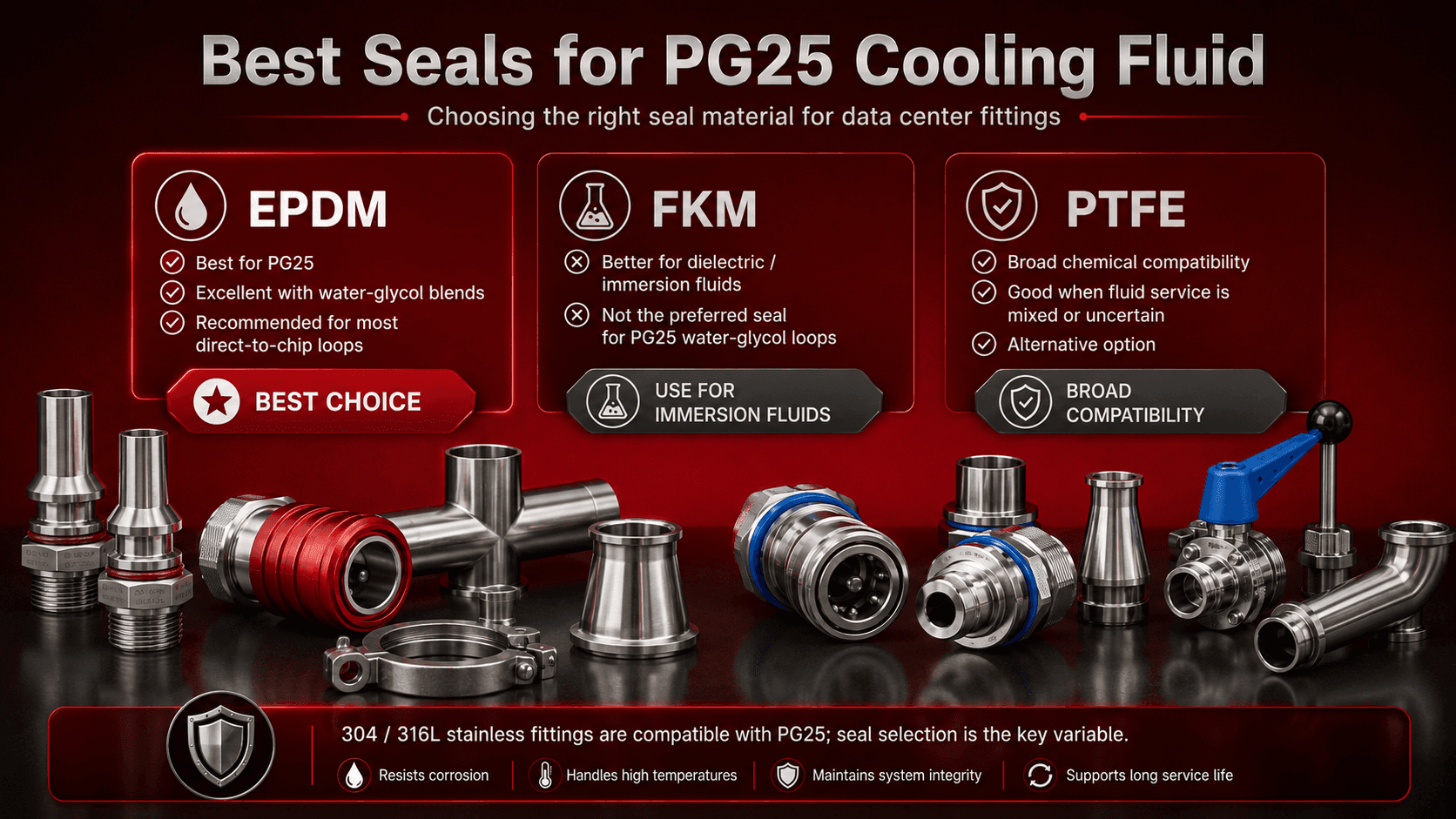
This is where fittings go wrong. The O-rings and seals in valves, couplings, and hose ends are elastomers, and elastomer compatibility depends entirely on the fluid:
- EPDM works well with water and water-glycol blends — but it must not be used with oil-based fluids, where it degrades. (We cover this specifically in Why EPDM Should Not Be Used With Oil-Based Fluids.)
- FKM (Viton) and related fluoroelastomers suit fluorinated and dielectric fluids of the kind used in immersion.
- PTFE offers broad chemical compatibility where the service is mixed or the fluid is uncertain.
Put the wrong elastomer in the path and it can swell, harden, or break down — and a seal that fails on the clean loop is a leak over live hardware. The metal can be perfect and the connection will still fail if the seal wasn't matched to the coolant. (Our companion piece on why coolant lines need different hose types goes deeper on matching materials to fluids.)
Cleanliness and the long game
Two more considerations run underneath the material choice.
- Cleanliness: whatever a component sheds heads downstream toward cold-plate microchannels that clog easily, so materials that stay stable and don't shed protect the whole loop.
- Maintenance: coolant is a managed system, and its inhibitor package depletes over time; compatible materials protect that chemistry, and the maintained chemistry in turn protects the materials. The two are a pair, designed together for a ten-year life.
Where Titan fits
Titan is a single-source solution provider for the connections these systems depend on — the adapters, fittings, quick disconnects, and valves you have to spec. And because Titan manufactures in the US, it turns orders around with one of the fastest lead times in the industry: weeks, not months.
Titan Fittings' stainless components — transition fittings, isolation ball valves, flexible hose connections, and 1-inch OCP LQC quick disconnects — are compatible with PG25, deionized water, and the full range of water-based coolants these loops run, in 304 and 316L. Because the metal path is compatible across the board, the compatibility question comes down to matching the seal to your fluid, and we'll help you get that right for the coolant you've specified.
Tell us your coolant and we'll help you spec the connection. See also 304 vs 316L for coolant loops and the full-loop overview