Why Stainless Beat Brass and Plastic for Liquid Cooling
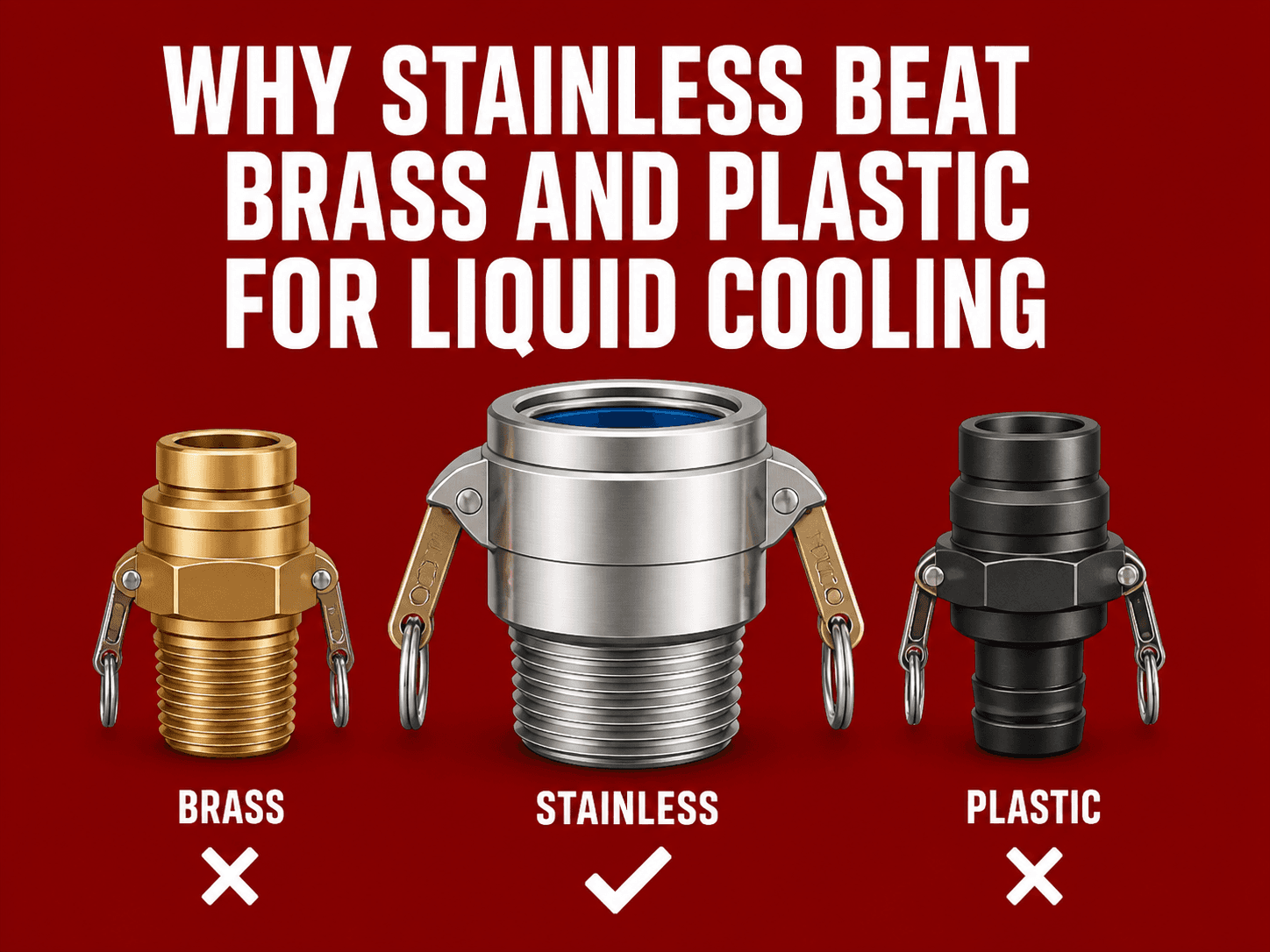
Data center cooling loops could be built from cheaper materials. Brass has plumbed buildings for a century; engineered plastics are lighter, cheaper, and easy to install. Both show up across the wider world of fluid handling. So why did mission-critical liquid cooling — the loops running coolant inches above racks of irreplaceable compute — standardize on stainless steel?
The short answer is stakes and time. This coolant runs above live hardware, on a closed loop expected to stay leak-tight and clean for a decade, ending in cold-plate passages measured in fractions of a millimeter. In that environment, the qualities that make brass and plastic fine elsewhere turn into liabilities. Here's the case, made fairly.
What brass does well — and where it falls short here
Brass has earned its place in potable water and general plumbing: it's machinable, corrosion-resistant enough for those duties, and inexpensive. In many HVAC and building-water contexts it's a perfectly good choice.
A controlled data center coolant loop is a different environment, and two issues follow brass into it. The first is dezincification — in certain water chemistries, brass can selectively lose its zinc, leaving a weakened, porous structure behind. On a connection you need to hold for ten years above electronics, that's a failure mode you'd rather design out entirely. The second is loop chemistry: a closed cooling loop with deionized water or inhibited glycol is a managed system, and adding a copper-zinc alloy introduces another metal — and the potential for its ions — into fluid that's supposed to stay clean and predictable. The fewer variables in that loop, the better it behaves over time.
None of this makes brass a bad metal. It makes it the wrong metal for this particular, unforgiving loop.
What plastic does well — and where it falls short here
Engineered plastics have real advantages: low cost, low weight, and fast installation. Plastic even has legitimate roles in these facilities — some distribution headers are run in polypropylene, and cost-sensitive, lower-demand sections can make sense in plastic.
But at the connection points that matter, plastic carries risks that stainless doesn't:
- Permeation. Many plastics let moisture and gases pass slowly through the material itself. Over years, that means coolant loss, air ingress, and chemistry drift in a loop that's supposed to stay sealed and stable.
- Temperature and pressure headroom. Plastic's margins shrink as things warm up, and warm coolant is the normal state of a working loop. Stainless doesn't flinch at the conditions plastic has to be derated for.
- Creep and aging. Plastics cold-flow under sustained load, so a joint torqued tight on install can relax over time, and some plastics embrittle as they age or see certain chemistries. A connection that loosens or grows brittle above a rack is exactly the failure you can't have.
- Particulate shedding. Anything the material sheds heads downstream toward cold-plate microchannels that clog easily. Cleanliness isn't a nicety on this loop; it's the whole point.
- Combustibility. Metal doesn't add fuel load in a room full of power and electronics. Plastic is a consideration there that stainless simply isn't.
Again, this isn't a verdict that plastic is useless — it's that the mission-critical joints, the ones over live hardware that have to last, aren't where its strengths pay off.
What stainless brings to this loop specifically
Set against those trade-offs, stainless lines up with what the loop actually demands:
- Corrosion resistance and cleanliness that hold up to deionized water and inhibited glycols without shedding into the fluid path.
- Strength with temperature and pressure headroom, so the connection isn't derated for the conditions it normally runs in.
- No meaningful permeation, keeping the closed loop closed and its chemistry stable.
- A decade-plus service life and leak-tight reliability on connections you don't want to revisit.
- Non-combustible, recyclable material in a room where both matter.
The quiet advantage: fewer variables
There's a systems argument on top of the material one. Building the coolant path in stainless — and only stainless — keeps the number of different metals in the loop low. That means fewer dissimilar-metal junctions to manage, consistent behavior end to end, and simpler sourcing for a component you buy by the thousand. Standardizing on one proven material removes a whole category of things that can go wrong.
Where Titan fits
Titan is a single-source solution provider for the connections these systems depend on — the adapters, fittings, quick disconnects, and valves you have to spec. And because Titan manufactures in the US, it turns orders around with one of the fastest lead times in the industry: weeks, not months.
Titan Fittings builds the coolant path in stainless only — 304 and 316L, no brass and no plastic anywhere in the fluid path — across transition fittings, isolation ball valves, flexible hose connections, and 1-inch OCP LQC quick disconnects. It's a deliberate choice that matches what these loops demand: clean, corrosion-resistant, leak-tight connections that hold for the life of the facility, compatible with PG25, deionized water, and the coolants in use today.
Tell us what you're building and we'll help you spec it. For the grade decision, see 304 vs 316L for coolant loops, and for the whole system, the full-loop overview