Flexible Hose Connections at the Rack Drop
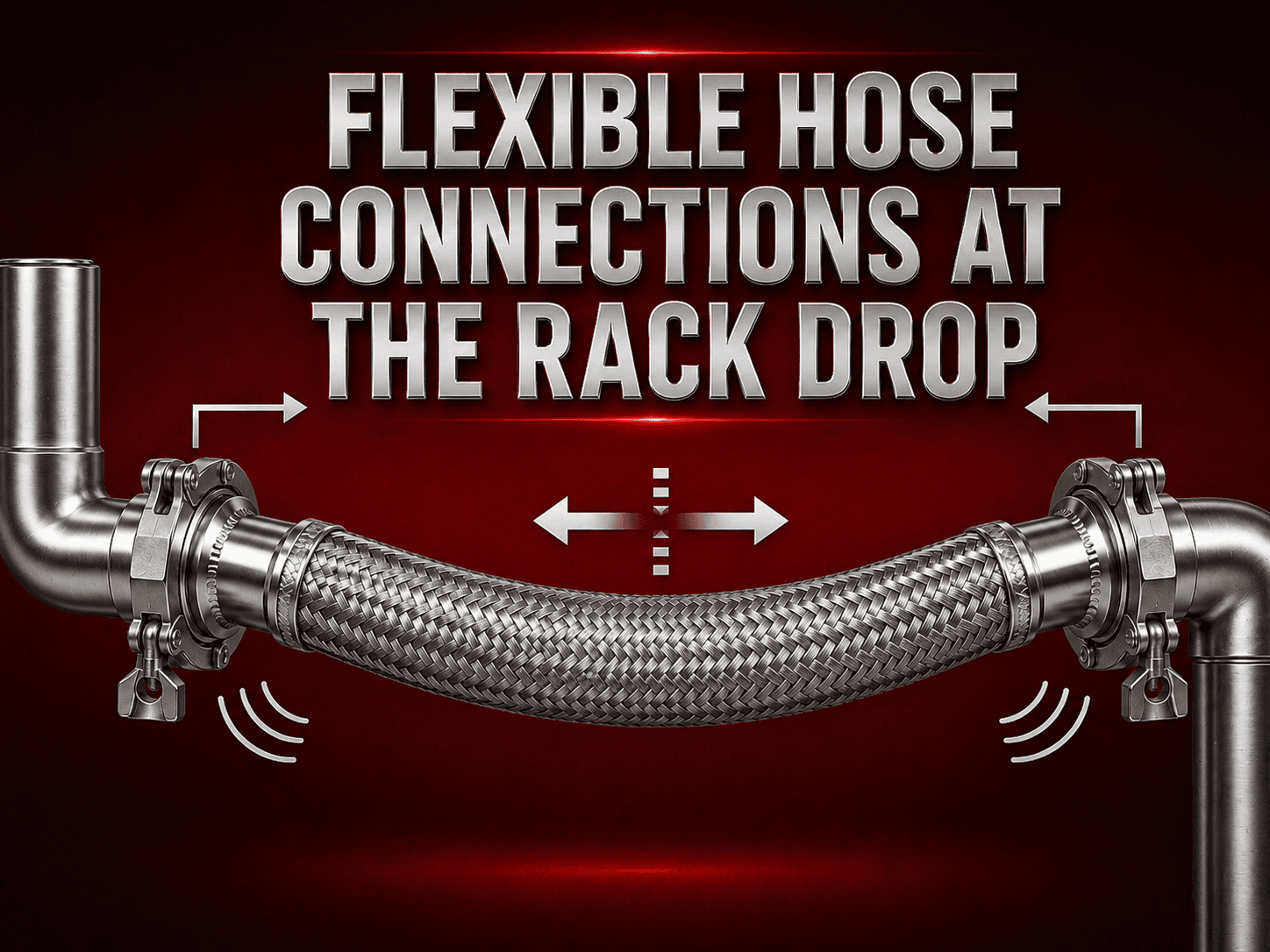
Every other component on a rack drop is rigid: the transition fitting, the isolation valve, the quick disconnect. The flexible hose is the one part that gives — and that's exactly why it's there. A header and a rack were never positioned to the millimeter, they move independently as the loop heats and cools, and racks get bumped during service. Something in the drop has to absorb all of that instead of passing it into the fittings as stress. That's the hose's job, and getting it right is the difference between a connection that lasts a decade and one that fatigues, weeps, or fights the crew every time a rack is serviced.
The three things a flexible hose absorbs
A rigid last connection to the rack assumes a fixed, permanent geometry. In a real hall, three forces work against that assumption:
- Misalignment. Field builds don't land the rack port and the header take-off in perfect line. A flexible hose bridges the offset that hard pipe would have to be bent or forced to meet.
- Thermal movement. The header and the rack expand and contract on their own schedules as coolant temperature swings. The hose takes up that relative growth; rigid pipe transmits it straight into the nearest joint as cyclic stress.
- Vibration. Pumps and flow put a low, continuous hum into the system. A hose damps it locally instead of letting it travel into the fittings and work them loose over time.
There's a fourth, practical reason: serviceability. A flexible hose turns the final connection into something a technician can route and mate by hand in a crowded aisle, rather than wrestling hard pipe into alignment behind a live rack. (For the full rigid-versus-flexible trade-off, see our rack-drop overview.)
Getting the hose right
A flexible hose only does its job if it's specified and installed for movement, not just for connection:
- Respect the bend radius. Every hose has a minimum bend radius; route it tighter and you crush the bore, spike the pressure drop, and cut its fatigue life. The drop should be laid out so the hose curves within spec, not forced around a hard corner.
- Length for movement, not slack. Too short and the hose is pulled taut and can't flex; too long and it sags and chafes. It should be sized to take up the expected motion with a little margin, then supported so it isn't hanging on its end fittings.
- Support and anchor the ends. The end fittings shouldn't carry the weight of the hose or the loads from the rest of the drop. Proper anchoring keeps the flex in the hose where it belongs.
Coolant compatibility is not optional
The hose sits on the clean side of the loop, so whatever it's made of has to live with the coolant for the life of the system. Deionized water is aggressive toward the wrong materials; propylene glycol blends like PG25 and other water-glycol mixes demand a bore and seals that won't degrade, swell, or shed anything into a loop that ends at a cold-plate microchannel. This is a place where a hose chosen on price alone comes back to haunt the build — a bore that breaks down doesn't just fail locally, it contaminates everything downstream.
The connection also has to stay clean and leak-tight at its ends. Matching the hose's end fittings to the transition fitting and valve on either side — in the same stainless family as the rest of the drop — keeps the joint count low and avoids introducing a dissimilar metal into the coolant path.
Where Titan fits
Titan is a single-source solution provider for the connections these systems depend on — the adapters, fittings, quick disconnects, and valves you have to spec. And because Titan manufactures in the US, it turns orders around with one of the fastest lead times in the industry: weeks, not months.
Titan Fittings supplies flexible hose connections with 304 and 316L stainless end fittings, selected for service with PG25, deionized water, and the glycol coolants these loops run — built to take up the misalignment, thermal movement, and vibration a rack drop sees. They're part of the same package as our transition fittings, isolation ball valves, and 1-inch OCP LQC quick disconnects, so the whole drop comes from one source and the metals match end to end.
Tell us your drop geometry and coolant and we'll help you spec the hose. For how it fits with the rest of the connection, see the rack drop, component by component, and the full-loop overview.